Share

Wednesday, March 20, 2019

Brett Kavanaugh Casts Deciding Vote, Ends 9th Circuit Court Reign of Terror On Key Issue


President Trump just got some great news as the Supreme Court, with Brett Kavanaugh casting the deciding vote, just ended the liberal 9th circuit court’s reign of terror.

Trump has complained about the runaway court as it has bloked many of Trump’s actions in the executive branch.

The court went along partisan lines and came back with a 5-4 decision and a big victory for Trump.

The 5-4 decision reversed the 9th Circuit Court of Appeals earlier ruling. Thankfully, Trump’s historic win and realignment of the courts is restoring sanity to America.

The Court sided with Trump and ruled that the U.S. government can detain immigrants with past criminal records without bond (for as long as needed) as they await deportation.

The four judges who opposed the ruling did so vehemently which goes to show what was at stake in America with the 2016 election. It is common sense to hold a criminal who is not a citizen, especially one who was violent, in custody before we deport them. Thankfully, America made a wise choice in Trump.

From CNN: The Supreme Court held on Tuesday that the government can detain — without a bond hearing — immigrants with past criminal records, even if years have passed since they were released from criminal custody.

The case centered on whether detention without a bond hearing must occur promptly upon an immigrant’s release from criminal custody or whether it can happen months or even years later when the individual has resettled into society. The statute says simply that the detention can occur “when the alien is released” from custody.

The court voted 5-4 in favor of the government.

In his opinion for the court, Justice Samuel Alito said that the immigrants in the case had argued they were “owed bond hearings” in order to argue for their release. Alito said that the law did not support their argument.

Justice Brett Kavanaugh wrote separately to say that the ruling was based entirely on the language of the statute at hand. He said it would be “odd” to interpret the statute as mandating the detention of certain “non citizens” who posed a serious risk of danger of flight, but “nonetheless” allow them to remain free during their removal proceedings if the executive branch failed “to immediately detain them upon their release from criminal custody.”

“The court correctly holds that the Executive Branch’s detention of the particular non citizens here remained mandatory even though the Executive Branch did not immediately detain them.”

From Reuters:

The court ruled 5-4, with its conservative justices in the majority and its liberal justices dissenting, that federal authorities could pick up such immigrants and place them into indefinite detention anytime, not just immediately after they finish their prison sentences.

The ruling, authored by conservative Justice Samuel Alito, left open the possibility of individual immigrants challenging the 1996 federal law involved in the case, called the Illegal Immigration Reform and Immigrant Responsibility Act, on constitutional grounds – their right to due process – if they are detained long after they have completed their sentences.

The law at issue states that the government can detain convicted immigrants “when the alien is released” from criminal detention. Civil rights lawyers for two groups of plaintiffs argued that the language of the law shows that it applies only immediately after immigrants are released. The Trump administration said the government should have the power to detain such immigrants anytime.

It is not the court’s job, Alito wrote, to impose a time limit for when immigrants can be detained after serving a prison sentence. Alito noted that the court repeatedly has said in the past that “an official’s crucial duties are better carried out late than never.”

Alito said the challengers’ assertion that immigrants had to be detained within 24 hours of ending a prison sentence is “especially hard to swallow.”

In dissent, liberal Justice Stephen Breyer questioned whether the U.S. Congress when it wrote the law “meant to allow the government to apprehend persons years after their release from prison and hold them indefinitely without a bail hearing.”

https://educationblogit.blogspot.com/2019/03/brett-kavanaugh-casts-deciding-vote.html?fbclid=IwAR3sGmAN4HTTdTejJHzkkaxJX18O8UVZNnn4Kchk6RItT3blVdJn_tKClIs#.XJFjQEf-U58.facebook

Friday, March 15, 2019

Watch Alex Jones Show

Watch Alex Jones Show: Alex Jones' Infowars: There's a war on for your mind!

How to protect your kids from Google predators

By Michelle Malkin  •  March 13, 2019 07:21 AM

How to protect your kids from Google predators
by Michelle Malkin
Creators Syndicate
Copyright 2019

The father of the World Wide Web is right: It’s time to take back “complete control of your data.”

Tim Berners-Lee, who conceived the first internet browser 30 years ago this week, warned of its increasing threats to “privacy, security and fundamental rights.” To mark the anniversary, he argued that demanding transparency is key to stopping the web’s “downward plunge to a dysfunctional future.” So, where to start?

Berners-Lee specifically cautioned against the dangers of internet browsers’ keeping “track of everything you buy.” The world’s top browser is Google Chrome. But spying on our purchases is the least we have to worry about with Google and its $800 billion parent company, Alphabet.

It’s bad enough that the company’s executives match your offline credit card purchases to your online user profile without full disclosure, employ mobile tracking apps that collect location data even if users have turned off location tracking, hide and downplay massive security breaches (like the photo-sharing “bug” and hacker-friendly browser “flaws” revealed this past week), bow to Chinese communist censors and exhibit explicit bias against conservatives. No, it’s much worse. Google’s predation starts early, often with the most vulnerable members of society: our children.

The Silicon Valley giant has hooked legions of children and teachers into its data mining products through lucrative partnerships with public schools across America. Learning no longer starts with A, B, C but with G, G, G:

G Suite, Gmail, Google Cloud, Google Drive, Google Docs, Google Sheets, Google Slides, Google Hangouts, Google Vault, Google Jamboard, Google Chromebooks and Google Classroom.

Don’t forget: Google now has 80 million educators and students around the world using G Suite for Education, 40 million students and teachers in Google Classroom and 30 million more using Google Chromebooks inside and outside the classroom. Despite a report last fall from the U.S. Department of Education’s inspector general blasting the feds for failing to investigate a backlog of Family Educational Rights and Privacy Act violations, the Trump White House has done nothing to repair the damage to FERPA done by the Obama administration. The Democrats’ tech-chummy bureaucrats busted open the door to third-party sharing of children’s personal data with government agencies, nonprofits and private educational technology vendors.

This is how Google has gotten away with unauthorized scanning and indexing of student email accounts (more here) and targeted online advertising based on search engine activity, as well as auto-syncing of passwords, browsing history and other private data across devices and accounts belonging to students and families unaware of default tracking.

While grandstanding opportunists in Congress now talk tough to Silicon Valley donors (hello, Elizabeth Warren), K-12 children in tens of thousands of schools began the academic year by lining up at the library to create Gmail accounts and Google Classroom logins without parental notification or permission. There’s no escape: No Google, no access. No access, no education. “Hell, some of the teachers don’t even teach the kids,” one parent complained to me. Instead, they “watch videos on Canvas on their Chromebooks.”

Canvas (by Instructure) is one of myriad “learning management systems” that stores students’ grades, homework assignments, videos, quizzes and tests — all integrated with almighty, all-powerful, omniscient Google. Google apps such as ClassDojo collect intimate behavioral data and long-term psychological profiles encompassing family information, personal messages, photographs and voice notes. The collection of such data is a nanny state nightmare in the making, as a new Pioneer Institute report on “social, emotional learning” software and assessments outlined this week. (See also: Who’s data-mining your toddlers.)

Meanwhile, preschoolers are being trained to flash “Clever Badges” with QR codes in front of their Google Chromebook webcams. These Badges “seamlessly” log them into Google World and all its apps without all the “stress” of remembering passwords. Addicted toddlers are being indoctrinated into the screen time culture without learning how to exercise autonomy over their own data.

Given the privacy breaches, public safety dangers, illegal data profiteering and child predation — not to mention the mental health crisis among America’s youngsters connected to social media pathologies — there should be a nationwide clamor to deplatform Google completely from public schools. Until that revolt among parents and educators across party lines swells, it’s up to moms and dads to seize control (thanks to parent watchdog Cheri Kiesecker for these tips):

1. Refuse to surrender your child’s privacy as the price of admission to school. Google logins must not be a requirement to participate in the classroom.

2. Demand disclosure of edutech terms of service for all apps, software and hardware.

3. If your child has already been dragooned into G Suite, dive into its “Activity Controls” and the “Manage Activity” section. Investigate the settings for password auto-save and auto sign-in, tracking of YouTube search and watch histories, live chat transcripts, sync and “Remove the Device” functions. Hold your school district’s administrators accountable for putting your kids’ privacy first.

4. Wean yourselves — not just your kids — off Google. Try the Brave browser, DuckDuckGo search engine, BitChute video hosting service, Minds or MeWe social networking, and ProtonMail.

Control begins with you, not G.

Michelle Malkin can be reached at MichelleMalkinInvestigates@protonmail.com.

The New American Podcast - Constitutional Carry Gaining Ground: Kentucky 16th State to Allow Permitless Concealed Carry | Free Listening on Podbean App

The New American Podcast - Constitutional Carry Gaining Ground: Kentucky 16th State to Allow Permitless Concealed Carry | Free Listening on Podbean App: On Tuesday, Kentucky Governor Matt Bevin signed into law Senate Bill 150, making Kentucky the 16th state to allow “constitutional carry.” The law states that “Persons age twenty-one (21) or older, and otherwise able to lawfully possess a firearm, may carry concealed firearms or other concealed deadly weapons without a license in the same locations as persons with valid licenses issued under KRS 237.110.”
Read the article here!

THE DOJ CANNOT INVESTIGATE ITSELF!: DOJ reached agreement with Clinton lawyers to block FBI access to Clinton Foundation emails, Strzok says

Image result for IMAGES OF STRZOK

By Gregg Re | Fox News

Clinton lawyers struck deal with DOJ to limit FBI access to Clinton Foundation emails, Strzok testifies

The Justice Department 'negotiated' an agreement with Hillary Clinton's legal team to block FBI access to emails on her private server regarding the Clinton Foundation, according to testimony from former FBI special agent Peter Strzok; Catherine Herridge has the details.

The Justice Department "negotiated" an agreement with Hillary Clinton's legal team that ensured the FBI did not have access to emails on her private servers relating to the Clinton Foundation, former FBI special agent Peter Strzok testified during a closed-door appearance before the House Judiciary Committee last summer, according to a newly released transcript.

Republicans late last year renewed their efforts to probe the Clinton Foundation, after tax documents showed a plunge in its incoming donations after Clinton’s 2016 presidential election. The numbers fueled longstanding allegations of possible “pay-to-play” transactions at the organization, amid a Justice Department probe covering foundation issues.

Under questioning from Judiciary Committee General Counsel Zachary Somers, Strzok acknowledged that Clinton's private personal email servers contained a mixture of emails related to the Clinton Foundation, her work as secretary of state and other matters.

"Were you given access to [Clinton Foundation-related] emails as part of the investigation?" Somers asked

CLINTON FOUNDATION WHISTLEBLOWERS HAVE COME FORWARD. WHAT ARE THEY SAYING?

"We were not. We did not have access," Strzok responded. "My recollection is that the access to those emails were based on consent that was negotiated between the Department of Justice attorneys and counsel for Clinton."

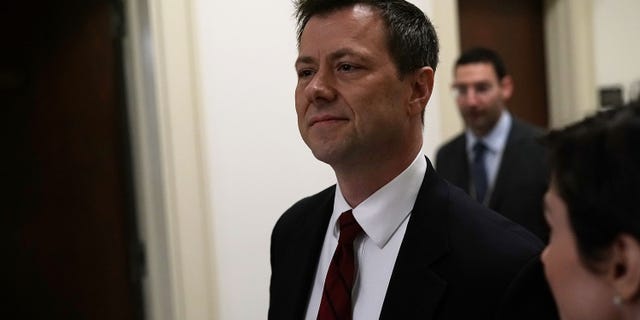
Peter Strzok arrives at a closed-door interview before the House Judiciary Committee in June. (Photo by Alex Wong/Getty Images)

Peter Strzok arrives at a closed-door interview before the House Judiciary Committee in June. (Photo by Alex Wong/Getty Images) (Photo by Alex Wong/Getty Images)

Although the FBI eventually took possession of the servers, Strzok continued, the possession was "based upon the negotiation of Department of Justice attorneys for consent."

"A significant filter team" was employed at the FBI, Strzok said, to "work through the various terms of the various consent agreements." Limitations imposed on agents' searches included date ranges, and names of domains and people, Strzok said, among other categories.

The agreement was reached, Strzok said, because “according to the attorneys, we lacked probable cause to get a search warrant for those servers and projected that either it would take a very long time and/or it would be impossible to get to the point where we could obtain probable cause to get a warrant.”

STRZOK'S PHONE FROM DAYS ON MUELLER PROBE TOTALLY WIPED; FBI SAYS SYSTEM-WIDE SOFTWARE FAILURE RESULTED IN OTHER MISSING TEXTS

Strzok did not elaborate on whether prosecutors made any effort to secure a search warrant, which could have delineated precisely what agents could and could not search.

But Strzok later said that agents had access to the "entire universe" of information on the servers when using search terms to probe their contents. He also told Somers that "we had it voluntarily," although it was unclear if he meant all emails on the servers -- including ones related to the Clinton Foundation.

Former Utah Rep. Jason Chaffetz, who chaired the House Oversight and Government Reform Committee until 2017 and is now a Fox News contributor, said the arrangement signaled that agents wanted willful blindness.

"They had no interest in pursuing the truth."

— Former Oversight committee chair Rep. Jason Chaffetz

"What's bizarre about this, is in any other situation, there's no possible way they would allow the potential perpetrator to self-select what the FBI gets to see," Chaffetz said, noting that the FBI was aware that the servers contained classified information in unclassified settings. "The FBI should be the one to sort through those emails -- not the Clinton attorneys."

The DOJ's goal, Chaffetz said, was to "make sure they hear no evil, see no evil -- they had no interest in pursuing the truth."

Chaffetz added that the DOJ's behavior, including its award of immunity to top Clinton aides early on in the investigation, signaled a clear double standard: "They didn't go make a deal with anyone in Trump's orbit. They seized it. They used guns and agents -- and just went in there and took it."

"The Clinton Foundation isn't supposed to be communicating with the State Department anyway," Chaffetz continued. "The foundation -- with her name on it -- is not supposed to be communicating with the senior officials at the State Department."

The Clinton Foundation did not respond to Fox News' request for comment.

Republican-led concerns that the DOJ, under the Obama administration, was too cozy with the Clinton team during the 2016 presidential campaign have grown louder in recent days. Earlier this week, Fox News exclusively reviewed an internal chart prepared by federal investigators working on the so-called "Midyear Exam" probe into Clinton's emails. The chart contained the words "NOTE: DOJ not willing to charge this" next to a key statute on the mishandling of classified information.

Judge Nap on John Ratcliffe's Tweet About Comey

Judge Nap on John Ratcliffe's Tweet About Comey

The notation appeared to contradict former FBI Director James Comey's repeated claims that his team made its decision that Clinton should not face criminal charges independently.

But Strzok, in his closed-door interview, denied that the DOJ exercised undue influence over the FBI, and insisted that lawyers at the DOJ were involved in an advisory capacity working with agents.

Fox News also confirmed the chart served as a critical tip that provided the basis for Texas Republican Rep. John Ratcliffe's explosive questioning of former FBI lawyer Lisa Page last year, in which Page agreed with Ratcliffe's characterization that the DOJ had told the FBI that "you're not going to charge gross negligence."

A transcript of Page's remarks was published Tuesday as part of a major document release by the ranking Republican on the House Judiciary Committee, Georgia Rep. Doug Collins.

Separately in the closed-door session, Strzok defended his affair with Page, repeatedly denying that the relationship presented a security risk when challenged by GOP aides.

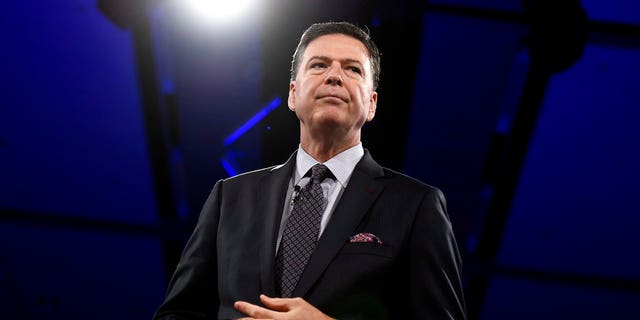
Former FBI director James Comey speaks during the Canada 2020 Conference in Ottawa on Tuesday, June 5, 2018. (Justin Tang/The Canadian Press via AP)

Former FBI director James Comey speaks during the Canada 2020 Conference in Ottawa on Tuesday, June 5, 2018. (Justin Tang/The Canadian Press via AP)

Strzok, who was fired from the bureau after months of scrutiny regarding anti-Trump text messages between him and Page, confirmed he was involved in an extramarital affair when asked about it during his interview before the committee on June 27, 2018. But Strzok was also asked by Art Baker, the GOP investigative counsel for the committee, whether that affair could have made him "vulnerable to potential recruitment" by "hostile intelligence service[s]."

“Yeah, I don’t think I would characterize it that way,” Strzok said. “I think it is not so much any particular action as it is the way that action might be used to coerce or otherwise get somebody to do something. I can tell you that in no way would that extramarital affair have any power in coercing me to do anything other than obeying the law and doing honest, competent investigation."

Fox News' Brooke Singman and Catherine Herridge contributed to this report.

Wednesday, March 13, 2019

Explosive Lisa Page Testimony: Dossier Timeline Contradictions And DOJ Interference

By Sara Carter

March 13, 2019

Testimony provided to Congress from former FBI lawyer Lisa Page reveals contradictions as to when she learned about former British spy Christopher Steele’s anti-Trump dossier, sheds light on the “insurance policy” and exposes the Obama Justice Department’s decision not to charge Hillary Clinton with allegedly violating the Espionage Act.

Page’s testimony, which was delivered behind closed doors last July before a joint task force of the House Oversight and Judiciary committees, reveals the internal machinations between senior bureau leadership and the DOJ. Basically, her testimony adds more depth to what happened during the critical months during the FBI’s investigation into President Trump’s election campaign and the bureau’s “Midyear Exam” investigation into Clinton.

As for the Clinton investigation, Page said the bureau “did not blow over gross negligence.” She told Rep. John Ratcliffe, R-Texas, there were ongoing discussions with former FBI Director James Comey and other senior officials about the issue. She said “on its face, it did seem like, well, maybe there’s a potential here for this to be the charge. And we had multiple conversations, multiple conversations with the Justice Department about charging gross negligence,” she said.

She added “the Justice Department’s assessment was that it was both constitutionally vague, so that they did not actually feel that they could permissibly bring that charge.”

Page’s testimony does coincide with what former FBI General Counsel James Baker’s told the committee on “gross negligence.” In testimony he stated that he originally believed Hillary Clinton’s mishandling of highly classified information was “alarming” and “appalling,”  as first reported at SaraACarter.com. He also believed her use of a private server to send the classified emails was sufficient enough to secure an indictment to possibly charge her for violations under the Espionage Act, for mishandling sensitive government documents.

However, her testimony focuses on the DOJ’s push not to charge Clinton, whereas Baker puts the onus on Comey. He said Comey did not believe the charges would stick and that he argued with Comey until just before the public announcement not to charge Clinton. Baker suggested he changed his mind shortly before Comey announced publicly on July 5, 2016 not to charge the then presidential candidate.

Crossfire Hurricane

Page also expands on the FBI’s controversial “Crossfire Hurricane” investigation into members of the Trump campaign and links the investigation to controversial text messages made between her and former FBI Special Agent Peter Strzok regarding the “insurance policy” against Trump. Strzok and Page were removed from Special Counsel Robert Mueller’s investigation after their anti-Trump text messages were discovered. Page left the FBI and Strzok was fired shortly after DOJ Inspector General Michael Horowitz report was made public last year.

Page expresses in her testimony that during the investigation into the Trump campaign there was a sentiment at the time among bureau officials regarding the president’s electability: nobody believed he would win.

“So, upon the opening of the crossfire hurricane investigation, we had a number of discussions up through and including the Director regularly in which we were trying to find an answer to the question, right, which is, is there someone associated with the [Trump] campaign who is working with the Russians in order to obtain damaging information about Hillary Clinton,” states Page.

She adds, “and given that it is August, we were very aware of the speed and sensitivity that we needed to operate under.”

“[W]e don’t need to go at a total breakneck speed because so long as he doesn’t become President, there isn’t the same threat to national security, right,” Page added. “But if he becomes President, that totally changes the game.”

Ohr and Page Testimony On Steele Don’t Match Up

Moreover, Page contradicts Ohr’s testimony regarding when she first knew about former British spy Christopher Steele’s dossier. She claims in her testimony that she did not know about the dossier in August 2016, however, Ohr’s testimony reveals that he delivered Steele’s information to the bureau shortly after meeting with Steele. In fact, he met with former Deputy Director Andrew McCabe and specifically, Page at the bureau to deliver the information.

Ohr reveals this during an exchange with then-Chairman of the House Oversight and Government Reform Committee Trey Gowdy, R-SC.

“Why? Why did you meet with them,” asks Gowdy.

“To pass the latest information that I had received,” Ohr responds.

“How did you find out who to meet with? Who did you call to find out,” questions Gowdy.

Ohr explains that prior to that meeting with McCabe and Page he had met with Steele on July 30, 2016.

“After the July 30th meeting with Chris Steele, I wanted to provide the information he had given me to the FBI. I reached out for Andrew McCabe, at that time, Deputy Director of the FBI and somebody who had previously led the organized crime, Russian organized crime squad in New York and who I had worked with in the past, and asked if he could meet with me,” he said.  “I went to his office to provide the information, and Lisa Page was there. So I provided the information to them. And some point after that, I think, I was given Peter Strzok, or somehow put in contact with Peter Strzok.”

Gowdy then asks when exactly did Ohr meet Strzok and Page.

“I don’t recall the exact date,” Ohr says. “I’m guessing it would have been in August since I met with Chris Steele at the end of July, and I’m pretty sure I would have reached out to Andrew McCabe soon afterwards.”

https://saraacarter.com/explosive-lisa-page-testimony-steele-timeline-contradictions-and-doj-interference/