
TiLTNews Network: Earth Watch - Freedom is defined by the ability of citizens to live without government interference, not by safety. It is easy to clamor for government security when terrible things happen; but liberty is given true meaning when we support it without exception, and we will be safer for it ~ Dr. Ron Paul
Wednesday, November 4, 2015
GUN SALES AT RECORD HIGH FOR 6TH STRAIGHT MONTH
“Barrack Obama and Hillary Clinton are the best gun salespeople on the planet."

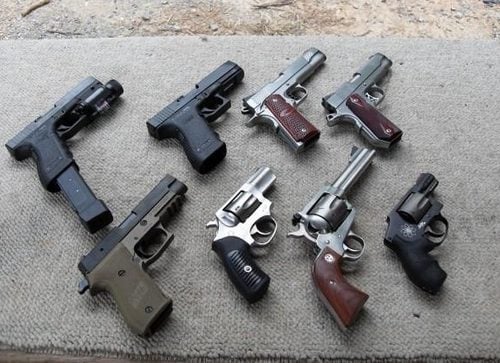
Image Credits: mwichary, flickr.
by STEVE WATSON | INFOWARS.COM | NOVEMBER 4, 2015
The level of FBI firearm related background checks in October again hit a record high, indicating that Americans have been buying firearms at all time highs for six months in a row now.
The FBI released October’s figures, showing that it carried out 1,976,759 Instant Background Checks. This makes it the sixth consecutive month to see a record number of checks.

It also constitutes a a 373,290 increase in checks on figures from this time last year.
While the figure, almost 2 million, does not represent a one to one calculation for gun sales, it is considered a reliable indicator of overall gun sales. Sales between private parties are not subject to background checks.
The FBI stats also show that 17,584,346 firearms related checks have been carried out in 2015, with two months still to go, the overall figure should easily surpass 2013’s record of 21,09,273 checks.
The reason for record gun sales, say gun rights activists, is the push for further gun control by Democrats.
“Barrack Obama and Hillary Clinton are the best gun salespeople on the planet,” said Alan Gottlieb, the head of the Second Amendment Foundation.
“The more they scream for new gun control laws the more guns walk off the shelves at gun stores,” Gottlieb added.
“To quote the lyrics of Peter, Paul and Mary, ‘When will they ever learn, when will they ever learn.’” he concluded.
The findings dovetail with a new poll that finds most Americans doubt the sincerity of politicians who raise gun issues.
Rasmussen recorded the finding, noting that Seventy-seven percent (77%) of Likely U.S. Voters in nearly every demographic category believe most politicians raise gun issues just to get elected rather than to address real problems.
—————————————————————
http://www.infowars.com/gun-sales-at-record-high-for-6th-straight-month/


Crude Prices Pump'n'Dump After 6th Consecutive Inventory Build & Surge In Production
Crude oil algos traders are buying WTI despite DOE reporting the 6th consecutive weekly inventory build in US crude stocks (confirming API's build at 2.8mm barrels). Furthermore, for the 3rd week in a row, US crude production rose (back to one-month highs)... and then the humans appeared to read the DOE report and the selling began.
Another weekly build in US crude inventories...

And for the 3rd week in a row production rose...

And crude rallies...

And then the humans read the report...

Charts: Bloomberg
It's Just Not Saudi Arabia's Year: First Oil Prices, Now This...

Submitted by Tyler Durden on 11/04/2015 12:46 -0500
Last week, in the latest sign of Saudi Arabia’s deteriorating financial condition, S&P downgraded the kingdom to AA- negative citing “lower for longer” crude and the attendant ballooning fiscal deficit.
To be sure, we’ve covered the story extensively and it was almost exactly one year ago that we flagged the quiet death of the petrodollar and explained the significance to a market that hadn’t yet woken up to just what it means when, thanks to plunging crude prices, producing nations cease to be net exporters of capital.
With more than $650 billion in SAMA reserves, Riyadh does have a sizeable cushion. However, there are a number of factors (in addition to low oil prices) that are weighing heavily including, i) financing the war in Yemen, ii) maintaining the lifestyle of everyday Saudis, and iii) preserving the riyal peg. Here's a look at the breakdown of government expenditures:

When you mix heavy outlays with declining revenue, it means dipping into the warchest…

Here's a bit of color from Deutsche Bank which helps to explain what we mean by "the cost of preserving the societal status quo":
The largest energy subsidy beneficiary is the end-consumer in the form of fuel (petrol) subsidies. Bringing up the price of petrol to levels in the UAE, which earlier this year eliminated the petrol subsidy, could provide the government with USD27bn incremental revenues, or 20% of the budget deficit. However, this is a highly unlikely scenario given the demographic differential between KSA and UAE and the socio-economic impact that such an outcome (blended prices rising from USD0.11/l to USD0.5/l) could have within the country.
The Saudi government could look to increase electricity tariffs. This would be a challenge for residential consumption (51% of aggregate consumption) given the political/social impact, though it would present the highest incremental revenue benefit. Bringing up the electricity rates for industrial/commercial consumers to UAE levels could raise incremental revenues of USD3bn, which, while higher than those from the chemical sector feedstock impact, is still only 2.3% of the budget deficit.
Water is another area where the government could raise more revenues. Currently consumers pay only SAR0.1/cu meter for consumption of 50 cu.m per month, which is one of the lowest in the world.

You get the idea. The Saudis are paying a heavy price to pacify the masses and ensure that some type of Arab Spring event doesn't come to Riyadh. This puts enormous pressure on the budget which leads directly to pressure on SAMA reserves when oil prices collapse.
In a sign of the times, the Saudis have also tapped the debt market, setting up a scenario where Riyadh’s debt-to-GDP ratio (which might as well have been zero) is now set to rise at least sevenfold by the end of next year and fifteenfold by 2020.

All of this suggets that S&P may be painting far too rosy a picture. That is, it’s not entirely clear that a 16% fiscal deficit is attainable this year, and we’re not sure it’s looking good for 10% in 2016. Here are Deutsche Bank's estimates:

As for the economy, well, it's set to decelerate meaningfully going forward.

Finally, note that for the first time in decades, the Saudis are actually staring down a current account deficit and speaking of trade, Bloomberg is out today with a particularly interesting assessment of the kingdom's aquifers which have run dry, meaning the country will no longer be able to grow wheat in the harsh desert environment. Here's more:
For decades, only a few features punctuated the vastness of the Saudi desert: oil wells, oases -- and wheat fields.
Despite torrid weather and virtually no rain, the world’s largest oil producer once grew so much of the grain that its exports could feed Kuwait, United Arab Emirates, Qatar, Bahrain, Oman and Yemen. The circular wheat farms, half a mile across with a central sprinkler system, spread across the desert in the 1980s and 1990s, visible in spring to anyone overflying the Arabian peninsula as green spots amid a dun sea of sand.
The oilfields remain, but the last wheat farms have just disappeared to save the aquifers supplying them. For the first time, Saudi Arabia will rely almost completely on wheat imports in 2016, a reversal from its policy of self-sufficiency. It will become a full member of the club of Middle Eastern nations that, according to the commodity-trade adage, "sell hydrocarbons to buy carbohydrates."
"The Saudis are the largest new wheat buyer to emerge," said Swithun Still, director of grain trader Solaris Commodities SA in Morges, Switzerland.
Ahmed bin Abdulaziz Al-Fares, managing director of the Grain Silos and Flour Mills Organization, the state agency in charge of cereal imports, told an industry conference in Riyadh last month that Saudi Arabia will import 3.5 million metric tons in 2016. That’s a 10-fold increase from about 300,000 tons in 2008, the first year local crops were curtailed. An agency presentation says the kingdom will rely on imports for "100 percent" of its wheat in 2016 for the first time.
By 2025, demand is forecast to rise to 4.5 million tons as population growth drives demand for flour, positioning Saudi Arabia as one of the 10 biggest wheat buyers worldwide.
It may not be the last country to turn away from growing its own crops. Aquifers in other key agricultural regions, including northern India and northern China, are also under pressure. The stress is compounded by erratic rains, which some blame on climate change.
Saudi Arabia became a net exporter of wheat in 1984 from producing almost none in the 1970s. The self-sufficiency program became a victim of its own success, however, as it quickly depleted aquifers that haven’t been filled since the last Ice Age. In an unexpected U-turn, the government said in 2008 it was phasing out the policy, reducing purchases of domestic wheat each year by 12.5 percent and bridging the gap progressively with imports.


In short, the Saudis are running out of money, water, and food and although the global deflationary supply glut (thank you ZIRP) means that importing things like wheat will be cheap for the time being ...

...moving away from self sufficiency as you deliberately suppress the price of your most important export while attempting to simultaneously fight two proxy wars and preserve costly subsidies for the oppressed masses is a dangerous cocktail, and with Tehran set to transition from pariah state to regional power broker we ask once again: is the House of Saud about to enter a terminal decline?
http://www.zerohedge.com/news/2015-11-04/its-just-not-saudi-arabias-year-first-oil-prices-now
EPA USED MONSANTO’S RESEARCH TO GIVE ROUNDUP A PASS
 Sharon Lerner Nov. 3 2015, 12:32 p.m.

THE ENVIRONMENTAL PROTECTION AGENCY concluded in June that there was “no convincing evidence” that glyphosate, the most widely used herbicide in the U.S. and the world, is an endocrine disruptor.
On the face of it, this was great news, given that some 300 million pounds of the chemical were used on U.S. crops in 2012, the most recent year measured, and endocrine disruption has been linked to a range of serious health effects, including cancer, infertility, and diabetes. Monsanto, which sells glyphosate under the name Roundup, certainly felt good about it. “I was happy to see that the safety profile of one of our products was upheld by an independent regulatory agency,” wrote Steve Levine on Monsanto’s blog.
But the EPA’s exoneration — which means that the agency will not require additional tests of the chemical’s effects on the hormonal system — is undercut by the fact that the decision was based almost entirely on pesticide industry studies. Only five independently funded studies were considered in the review of whether glyphosate interferes with the endocrine system. Twenty-seven out of 32 studies that looked at glyphosate’s effect on hormones and were cited in the June review — most of which are not publicly available and were obtained by The Intercept through a Freedom of Information Act request — were either conducted or funded by industry. Most of the studies were sponsored by Monsanto or an industry group called the Joint Glyphosate Task Force. One study was by Syngenta, which sells its own glyphosate-containing herbicide, Touchdown.
Findings of Harm Were Dismissed
Who pays for studies matters, according to The Intercept’s review of the evidence used in the EPA’s decision. Of the small minority of independently funded studies that the agency considered in determining whether the chemical poses a danger to the endocrine system, three of five found that it did. One, for instance, found that exposure to glyphosate-Roundup “may induce significant adverse effects on the reproductive system of male Wistar rats at puberty and during adulthood.” Another concluded that “low and environmentally relevant concentrations of glyphosate possessed estrogenic activity.” And a review of the literature turns up many more peer-reviewed studies finding glyphosate can interfere with hormones, affecting such things as hormonal activity in human liver cells, functioning of rat sperm, and the sex ratio of exposed tadpoles.
Yet, of the 27 industry studies, none concluded that glyphosate caused harm. Only one admitted that the pesticide might have had a role in causing the health problems observed in lab animals exposed to it. Some rats that consumed it were more likely to have to have soft stools, reduced body weight, and smaller litters. But because that evidence didn’t meet a test of statistical significance, the authors of the Monsanto study deemed it “equivocal.”
Indeed, many of the industry-funded studies contained data that suggested that exposure to glyphosate had serious effects, including a decrease in the number of viable fetuses and fetal body weight in rats; inflammation of hormone-producing cells in the pancreas of rats; and increases in the number of pancreatic cancers in rats. Each is an endocrine-related outcome. Yet in each case, sometimes even after animals died, the scientists found reasons to discount the findings — or to simply dismiss them.
When rats exposed to glyphosate had a decreased number of pregnancies that implanted, for instance, the authors of a 1980 Monsanto-sponsored study explained that “since ovulation and implantation occurred prior to treatment, the decreases … were not considered to be treatment related.” Although they noted that the decrease in implantations and viable fetuses was “statistically significant,” the authors nonetheless concluded that the decrease in implantations was a random occurrence.
While recent research has shown that very low doses of endocrine disruptors can not only have health effects but effects that are more dramatic than those caused by higher doses, some of the studies dismiss clear examples of harm because they occur in animals given relatively low doses of the substance. A study prepared by Monsanto in 1990, for instance, noted a statistically significant increase in pancreatic cancers among rats exposed to a relatively low dose of Roundup. The rats had a 14 percent chance of cancer, compared to a 2 percent chance in the control group. But since some rats exposed to higher amounts of the chemical had lower cancer rates, the scientists concluded the elevation was “unrelated to glyphosate administration.”
A Flawed System
Independent scientists may come up with different results than industry-funded ones for a variety of reasons, including how a study is designed or carried out. But Michelle Boone, a biologist who served on an EPA panel that evaluated the safety of atrazine, another pesticide, told The Intercept that analysis of those results is an area particularly ripe for bias. “Once you have industry intimately involved in interpreting the data and how it’s written up, it’s problematic.”
Having companies fund and perform studies that affect them financially would seem to be an obvious conflict of interest, but that’s the standard practice at EPA. The glyphosate review, which was completed in June, was one of 52 reporting on the endocrine disrupting potential of pesticides, all of which relied heavily on industry-funded research and most of which concluded, as the one of glyphosate did, that there was no cause for further testing. (Though marketed as a weed killer, or herbicide, glyphosate is considered to be a pesticide by the EPA.)
Asking chemical companies to do their own testing makes financial — if not scientific — sense for the cash-strapped federal agency. Monsanto, which had more than $15.8 billion in net sales last year (roughly twice the EPA’s annual budget), can easily foot the research bill. Companies like Monsanto, Syngenta, or Dow can either do the research themselves or hire contract research labs, such as Wildlife International or CeeTox, Inc., which supplied much of the research for the glyphosate review.
But the fact that these labs depend upon the large corporations that employ them as evaluators can’t help but skew their findings, according to critics of the system. “They know who’s buttering their toast,” said Doug Gurian Sherman, a senior scientist at the Center for Food Safety and former staff scientist at the EPA Office of Pesticide Programs. “It’s not that people are going to necessarily do something clearly fraudulent. It’s more that it puts a pressure to shave things in a direction to whoever’s paying the bills.”
The process can be distorted beginning with the very first step, when a company chooses which lab will perform its tests. “Industry is very aware of companies they can hire that have never found an estrogen positive chemical,” said Laura Vandenberg, a professor of biology at University of Massachusetts, Amherst, who specializes in endocrine disruption and hazard assessment. “Just like you know which mechanic in your neighborhood is more likely to be dishonest. They know who is more likely to give them a favorable finding.”
The EPA defended its process in a statement. “We want to make clear that EPA maintains a transparent, public process for assessing potential risks to human health when evaluating pesticide products,” it began. The agency statement also pointed out that the law requires pesticide companies to provide studies supporting their products. “Once studies are submitted to the agency, EPA scientists analyze the data to ensure that the design of the study is appropriate and that the data have been collected and analyzed accurately.”
Syngenta responded in a statement that pointed out that pesticide companies have to provide data to the EPA: “The law requires manufacturers do extensive scientific studies to prove a new compound is safe. EPA controls and documents the studies’ strict adherence to its guidelines. This provides the highest level of transparency to the agency, fellow scientists and the public.”
A spokesperson for Monsanto wrote in an email that “the government requires many, many studies to make sure herbicides can be used safely. While some of these studies are required to come from us, many of these studies are conducted by third-party scientists and labs. The EPA looked at 11 different validated assays assessing the potential for effect of glyphosate on endocrine pathways in humans and wildlife. Based on its review of the data, EPA concluded ‘there was no convincing evidence of potential interaction with the estrogen, androgen or thyroid pathways’ and this conclusion is consistent with the results from other safety studies conducted in accordance with international and assessment guidelines.” Dow, Wildlife International, and CeeTox, Inc. did not respond to The Intercept’s requests for comment.
A False Sense of Security
The dependence on industry is just one of several limitations of the EPA’s effort to screen pesticides for their potential to interfere with the way androgen, estrogen, and thyroid hormones work. The effort has also been dogged by delays. Congress mandated that the agency begin screening to see whether pesticides were endocrine disruptors back in 1996. Yet the screenings of the 52 pesticides in June were the first to emerge from the program in almost 20 years since the testing was required.
In the intervening time, our knowledge about endocrine disruptors has exploded, leaving many of the tests on them out of date. Indeed, many of the studies submitted for the glyphosate review dated back to the 1970s. One was 40 years old. In all, 15 of the 27 industry studies predated the term “endocrine disruption,” which was coined in 1991.
Perhaps the most important discovery in the area of endocrine research in the decades since those studies were performed is that even small amounts of hormonally active chemicals can have powerful effects. Yet the cutoffs used in the EPA’s screening program were far higher than the lowest levels shown to have effects in the latest research.
“We see effects at levels that are 1,000 times lower” than the cutoff EPA uses, said Vandenberg, who warned of the false sense of security given by such insensitive screenings. “It’s like putting your deaf grandfather in front of a TV and asking him if he can hear it and when he says no, you conclude the TV is off.”
Almost as problematic as the industry-provided data, some critics say, is the research the agency doesn’t consider. “They exclude studies that others in the field would consider to be perfectly good,” said Sherman, of the Center for Food Safety. Or, as was the case in the glyphosate review, findings of harm by independently conducted studies may be considered but discounted.
While independent scientists have complained about the role of the pesticide industry in its own regulation for years — and suggested ways to fix it, including discounting any studies that have a conflict of interest — there’s little progress on that front.
In fact, having cleared this review, glyphosate is now about to face another regulatory hurdle that, while bigger, is similarly flawed. Every 15 years, the EPA must review pesticides on the market in light of the latest science. Glyphosate’s review, which will include research on its health effects on humans and is expected to be completed in the next few months, is the first to come after the International Agency for Research on Cancer labeled glyphosate a probable carcinogen in March. If the EPA doesn’t reregister glyphosate, it could be essentially banned, as it already is in France and Sri Lanka.
Monsanto seems optimistic its product will survive the coming EPA review, noting in the blog post about the recent EPA review that “glyphosate’s safety is supported by one of the most extensive worldwide human health databases ever compiled on an agricultural product.”
Unfortunately, Monsanto has supplied most of that data
It Begins… Democrat Lawmaker Proposes $100 Tax on Every Gun
Democrat Rep. Nydia Velazquez (D-NY) proposed legislation that will place a $100 tax per firearm.

It’s another good way of getting guns out of the hands of law abiding Americans and into the hands of criminals.
Only a Democrat would think this is a good idea.
AL.com reported:A new bill would tax gun owners at a rate of $100 per firearm with proceeds going towards anti-violence and mental health programs.
Rep. Nydia Velazquez, D-NY., said the measure would reduce the number of guns in circulation and providing needed funding for programs aimed at reducing violence. The legislation will be introduced in the U.S. House this week.
“Gun violence is a plague on our city that shatters lives and tears families apart,” Velázquez said. “This bill will take meaningful steps to address the issue, reducing the flow of guns on the street, empowering law enforcement to better track missing weapons, while investing in community anti-violence programs.”
Velazquez’s proposal would assess a $100 federal tax on the sale of all new firearms. Revenue generated from the tax would go to the Department of Justice for safety and mental health improvement grants.
“If making guns more expensive means fewer end up in commerce, I’m happy with that result,” Velázquez said. “However, if guns are going to be sold, then those purchasing and selling them should pay for programs that can reduce the incidence of gun violence in our local communities.”
The post It Begins… Democrat Lawmaker Proposes $100 Tax on Every Gun appeared first on The Gateway Pundit.
It Begins… Democrat Lawmaker Proposes $100 Tax on Every Gun
Jim Hoft
Wed, 04 Nov 2015 17:26:03 GMT
The Punishment Society
This article was posted: Wednesday, November 4, 2015 at 11:47 am
Paul Craig Roberts | Police can slam children around and seriously injure them. But parents must not lay a hand on a child.
Once upon a time, a dental or medical exam was an opportunity to read a book. No more. The TV blares. It was talking heads discussing whether a football player had been sufficiently punished. The offense was unclear. The question was whether the lashes were sufficient.
It brought to mind that punishment has become a primary feature of American, indeed Western, society. A baker in Colorado was punished because he would not bake a wedding cake for a homosexual marriage. A county or state clerk was punished because she would not issue a marriage license for a homosexual marriage. University professors are punished because they criticize Israel’s inhumane treatment of Palestinians. Whistleblowers are punished—despite their protection under federal law—for revealing crimes of the US government. And children are punished for being children.
But not by their parents. Police can slam children around and seriously injure them. But parents must not lay a hand on a child. If a child gets spanked, as everyone in my generation was, in comes the Child Protective Services Gestapo. The child is seized, put into “protective custody,” and the parents are arrested. The CPS Gestapo receives a federal bonus for every child that they seize, and they want the money.
About all parents can do today is to restrict TV or video game playing time. Even this is dicey, because the kids are taught at school to report abusive behavior of parents. For many kids being told what to do by parents is abusive behavior. Kids have learned that they can pay back parents for disciplining them by reporting the parents to teachers or by themselves calling CPS. Kids who retaliate in this socially approved manner do not realize that they run a high risk of ruining the lives of their parents as well as their own by ending up in foster care where the risk of sexual abuse is present.
As society has made it possible for kids to prevail over parents, the kids think this right also applies to teachers, school administrators, and School Resource Officers, psychopaths with police badges who maintain discipline with force and violence. The kids quickly discover,as Shakara discovered in her encounter with Ben Fields, that whereas parents are constrained from using corporal punishment, School Resource Officers are not. Shakara’s desk was overturned as she sat in it. She was slammed onto the floor, dragged across the floor and handcuffed. Any parent who did that would be facing jail time.
Schools are no longer places of learning. They are places of punishment. Kids are punished for the most absurd reasons. Nothing more than behaving as a child brings on punishment. As Henry Giroux has written, schools have become places of control, repression, and punishment.
17,000 American public schools have a police presence. All common sense has long departed.
Five and six year-olds who get into a shoving match are arrested and carried off in handcuffs. Police issue tickets and fines to students for what was ordinary behavior in my school days. Suspensions result as do police records that hamper a child’s prospect of success.
The violence that Ben Fields used against Shakara is routine. Mother Jones reports that a Louisville goon thug, Jonathan Hardin punched a 13-year old in the face for cutting into the cafeteria line and of holding another 13-year old in a chokehold until the student became unconscious. A dispute over cell phone use resulted in a Houston student being hit 18 times with a police weapon.
The police violence extends beyond the schools. Any American unfortunate enough to have a police encounter risks being tasered, beaten, arrested, and even murdered.
Protesters, war and otherwise, are beaten, tear gassed, arrested. The American police state is working hard to criminalize all criticism of itself. Violence has become the defining hallmark of the United States. It is even the basis of US foreign policy. In the 21st century millions of peoples have been killed and displaced by American violence against the world.
With our public schools and police forces working overtime to teach the children who will comprise the future generations that violence is the solution and submission is the only alternative, expect the United States to be unliveable at home and an even worse danger to the rest of the world.
Paul Craig Roberts was Assistant Secretary of the Treasury for Economic Policy and associate editor of the Wall Street Journal. He was columnist for Business Week, Scripps Howard News Service, and Creators Syndicate. He has had many university appointments. His internet columns have attracted a worldwide following. His latest book, The Failure of Laissez Faire Capitalism and Economic Dissolution of the West is now available.
The Punishment Society
admin
Wed, 04 Nov 2015 16:47:09 GMT
Tuesday, November 3, 2015
Monday, November 2, 2015
A Brief History Of Crime: How The Fed Became The Undemocratic, Corrupt & Destructive Force It Is Today
Submitted by Tyler Durden on 11/02/2015 22:20 -0500
- Federal Reserve
- Federal Reserve Bank
- fixed
- Great Depression
- Quantitative Easing
- Regional Banks
- Wall Street Journal
Submitted by Mike Krieger via Liberty Blitzkrieg blog,
Perhaps the most famous, and prescient, financial cartoon in American history is the depiction of the Federal Reserve Bank as a giant octopus that would come to parasitically suck the life out of all U.S. institutions as well as free markets. The image is taken from Alfred Owen Crozier’s US Money Vs Corporation Currency, “Aldrich Plan,” Wall Street Confessions! Great Bank Combine, published in 1912, just a year before the creation of the Federal Reserve. Here it is in all its glory:

Our ancestors were wiser and far more educated than modern Americans about the dangers posed by a centralized, monopolistic system charged with the creation and distribution of money, and our society and economy have paid a very heavy price for its ignorance.
Indeed, some of today’s Fed critics aren’t even aware that the U.S. Central Bank originally had far less power than it does today. As concerned as they were, its early critics could never have imagined how perverted its mandate would become in the subsequent 100 years. A mandate that has now made it the single most powerful and destructive force on planet earth.
Earlier today, I came across an excellent op-ed in the Wall Street Journal in which the author explains this transformation in just a few short paragraphs. Here’s some of what he wrote:
History suggests that the only way to rein in the sprawling Federal Reserve is to end its money monopoly and restore the American people’s ability to use gold as a competing currency.
The legislative compromise that created the Fed in 1913 recognized that the power to print money, left unchecked, could corrupt both the government and the economy. Accordingly, the Federal Reserve Act created the Federal Reserve System without a centralized balance sheet, a central monetary-policy committee or even a central office.
The Fed’s regional banks were prohibited from buying government debt and required to maintain a 40% gold reserve against dollars in circulation. Moreover, each of the reserve banks was obligated to redeem dollars for gold at a fixed price in unlimited amounts.
Over the past century, every one of these constraints has been removed. Today the Fed has a centrally managed balance sheet of $4 trillion, and is the largest participant in the market for U.S. government bonds. The dollar is no longer fixed to gold, and the IRS assesses a 28% marginal tax on realized gains when gold is used as currency.
The largest increases in the Fed’s power have occurred at moments of financial stress. Federal Reserve banks first financed the purchase of government bonds during World War I. The gold-reserve requirement was dramatically reduced and a central monetary policy-committee was created during the Great Depression. President Richard Nixon broke the last link to gold to stave off a run on the dollar in 1971.
This same combination of crisis and expediency played out in 2008 as the Fed bailed out a series of nonbank financial institutions and initiated a massive balance-sheet expansion labeled “quantitative easing.” To end this cycle, Americans need an alternative to the Fed’s money monopoly.
And that, in a nutshell, is how American citizens lost their country and became a nation of debt serfs.
Sunday, November 1, 2015
Why Did San Francisco's Last Gun Shop Close Its Doors?
‘
Originally posted October 30, 2015:
Over the weekend, San Francisco will lose its last gun store: High Bridge Arms.
Why? The city has mandated that gun shops hand over information about its customers to the cops.
"Just the idea of giving that information willingly to the police department, for no real reason, seemed very unreasonable to me." says Steven Alcairo, the general manager of High Bridge Arms. Alcairo notes that the store already complies with all federal and state reporting requirements.
Mark Farrell, a member of San Francisco’s Board of Supervisors, was behind the local ordinance. The ordinance places new requirements on gun shops like High Bridge Arms, such as videotaping everything that happens in their stores and providing the San Francisco Police Department with weekly updates on customers and purchases.
"I would never introduce legislation to hurt a small business in our city," Farrell told the local NBC affiliate. "However, if a gun store in particular wants to close as a result of it, so be it."
High Bridge Arms' website says the shop was opened in 1952 by the renowned Olympic shooter Bob Chow. It was later bought by Andy Takahashi in the late 1980s. It was Takahashi who made the decision to close the doors.
"You know, I think I would like it if San Franciscans would just kinda take a look at this," says Alcario. "We decriminalized medical marijuana, we pioneered equal rights. But in the same town you’re gearing laws specifically to make it hard on me,"
About 3 minutes. Produced by Alex Manning. Filmed by Paul Detrick. Music by Podington Bear.

Why Did San Francisco's Last Gun Shop Close Its Doors?
Alex Manning
Sun, 01 Nov 2015 14:30:00 GMT