Share

Saturday, October 10, 2015

The Tragic Ending To Obama's Bay Of Pigs: CIA Hands Over Syria To Russia


Tyler Durden's picture Submitted by Tyler Durden on 10/10/2015 22:06 -0400

One week ago, when summarizing the current state of play in Syria, we said that for Obama, "this is shaping up to be the most spectacular US foreign policy debacle since Vietnam." Yesterday, in tacit confirmation of this assessment, the Obama administration threw in the towel on one of the most contentious programs it has implemented in "fighting ISIS", when the Defense Department announced it was abandoning the goal of a U.S.-trained Syrian force.

But this, so far, partial admission of failure only takes care of one part of Obama's problem: there is the question of the "other" rebels supported by the US, those who are not part of the officially-disclosed public program with the fake goal of fighting ISIS; we are talking, of course, about the nearly 10,000 CIA-supported "other rebels", or technically mercenaries, whose only task is to take down Assad.

The same "rebels" whose fate the AP profiles today when it writes that the CIA began a covert operation in 2013 to arm, fund and train a moderate opposition to Assad. Over that time, the CIA has trained an estimated 10,000 fighters, although the number still fighting with so-called moderate forces is unclear.

The effort was separate from the one run by the military, which trained militants willing to promise to take on IS exclusively. That program was widely considered a failure, and on Friday, the Defense Department announced it was abandoning the goal of a U.S.-trained Syrian force, instead opting to equip established groups to fight IS.

It is this effort, too, that in the span of just one month Vladimir Putin has managed to render utterly useless, as it is officially "off the books" and thus the US can't formally support these thousands of "rebel-fighters" whose only real task was to repeat the "success" of Ukraine and overthrow Syria's legitimate president: something which runs counter to the US image of a dignified democracy not still resorting to 1960s tactics of government overthrow. That, and coupled with Russia and Iran set to take strategic control of Syria in the coming months, the US simply has no toehold any more in the critical mid-eastern nation.

And so another sad chapter in the CIA's book of failed government overthrows comes to a close, leaving the "rebels" that the CIA had supported for years, to fend for themselves.

From AP:

CIA-backed rebels in Syria, who had begun to put serious pressure on President Bashar Assad's forces, are now under Russian bombardment with little prospect of rescue by their American patrons, U.S. officials say.

Over the past week, Russia has directed parts of its air campaign against U.S.-funded groups and other moderate opposition in a concerted effort to weaken them, the officials say. The Obama administration has few options to defend those it had secretly armed and trained.

The Russians "know their targets, and they have a sophisticated capacity to understand the battlefield situation," said Rep. Mike Pompeo, R-Kan., who serves on the House Intelligence Committee and was careful not to confirm a classified program. "They are bombing in locations that are not connected to the Islamic State" group.

With the US now in damage control mode, the finger pointing begins.

First, it is only natural that finger will point at Putin - after all he is an easy target:

U.S. intelligence officials see many factors motivating Russia's intervention: Moscow's reasserting its primacy as a great power, propping up Assad and wanting to deal a blow to the United States, which has insisted that Assad must go to end Syria's civil war.

Russia is also interested in containing IS, an organization that includes thousands of Chechen fighters who may pose a threat to Russia, officials say.

But in the short term, "my conclusion is that the timing of their intervention was driven by Assad really going critical," said Rep. Jim Himes, D-Conn., also a House Intelligence Committee member.

Alas, blaming Putin only underscores his latest victory over the US state department, leaving the US diplomatic corps no choice but to blame its own. This is imminent, and many heads will - or should - roll.

The administration is scrambling to come up with a response to Russia's moves, but few believe the U.S. can protect its secret rebel allies. The administration has all but ruled out providing CIA-backed groups with surface-to-air missiles that can down aircraft, fearing such weapons would end up in the wrong hands, officials say.

Rep. Adam Schiff, the top Democrat on the committee, says the U.S. should consider establishing a no-fly zone that allows rebels a safe place from which to operate, and shooting down Syrian helicopters that are bombing civilians. He said the U.S. also should provide arms to the Ukrainian government fighting Russian-backed separatists.

A no-fly zone would require the U.S. military to be ready to engage in air battles with the Syrian government, something it is not prepared to do.

Why? Because it is not the Syrian government that is flying those sorties above Syria, it is Putin, and despite all the posturing, Obama is unwilling to risk World War III just to stop a Qatar gas pipeline to Europe.

Which means Obama now has just one option: admitting that his latest gamble to overthrow Assad, one which started in 2013 with the fake YouTube clips of "chemical attacks", and the resultant naval escalation, coupled with the CIA's training of thousands of local rebels mercenaries, and which escalated with the "appearance" of ISIS in the summer of 2014, is about to end with Obama admitting yet another major political defeat.

The administration "is debating the merits of taking further action or whether they are better off letting Putin hang himself," he said, referring to Russian President Vladimir Putin.

Because somehow handing over control of the Middle East to the Russian-controlled axis - incidentally the topic of another article yesterday in the WSJ "America's Fading Footprint in the Middle East" - is now spun as a defeat for Putin.

"Our options are much narrower than they were two weeks ago," said Sen. Angus King, I-Maine, who serves on the Intelligence and Armed Services committees. "I don't think there is any simple answer. ... Further air involvement has become very problematic because of the Russian engagement."

* * *

And so Putin has once again "won", or as the administration would prefer to spin it, "has hung himself."

Incidentally, this is just the beginning. Now that the U.S. has begun its pivot out of the middle-east, handing it over to Putin as Russia's latest sphere of influence on a silver platter, there will be staggering consequences for middle-east geopolitics. In out preview of things to come last week, we concluded by laying these out; we will do the same again:

The US, in conjunction with Saudi Arabia and Qatar, attempted to train and support Sunni extremists to overthrow the Assad regime. Some of those Sunni extremists ended up going crazy and declaring a Medeival caliphate putting the Pentagon and Langley in the hilarious position of being forced to classify al-Qaeda as "moderate." The situation spun out of control leading to hundreds of thousands of civilian deaths and when Washington finally decided to try and find real "moderates" to help contain the Frankenstein monster the CIA had created in ISIS (there were of course numerous other CIA efforts to arm and train anti-Assad fighters, see below for the fate of the most "successful" of those groups), the effort ended up being a complete embarrassment that culminated with the admission that only "four or five" remained and just days after that admission, those "four or five" were car jacked by al-Qaeda in what was perhaps the most under-reported piece of foreign policy comedy in history.

Meanwhile, Iran sensed an epic opportunity to capitalize on Washington's incompetence. Tehran then sent its most powerful general to Russia where a pitch was made to upend the Mid-East balance of power. The Kremlin loved the idea because after all, Moscow is stinging from Western economic sanctions and Vladimir Putin is keen on showing the West that, in the wake of the controversy surrounding the annexation of Crimea and the conflict in eastern Ukraine, Russia isn't set to back down. Thanks to the fact that the US chose extremists as its weapon of choice in Syria, Russia gets to frame its involvement as a "war on terror" and thanks to Russia's involvement, Iran gets to safely broadcast its military support for Assad just weeks after the nuclear deal was struck. Now, Russian airstrikes have debilitated the only group of CIA-backed fighters that had actually proven to be somewhat effective and Iran and Hezbollah are preparing a massive ground invasion under cover of Russian air support. Worse still, the entire on-the-ground effort is being coordinated by the Iranian general who is public enemy number one in Western intelligence circles and he's effectively operating at the behest of Putin, the man that Western media paints as the most dangerous person on the planet.

As incompetent as the US has proven to be throughout the entire debacle, it's still difficult to imagine that Washington, Riyadh, London, Doha, and Jerusalem are going to take this laying down and on that note, we close with our assessment from Thursday:  "If Russia ends up bolstering Iran's position in Syria (by expanding Hezbollah's influence and capabilities) and if the Russian air force effectively takes control of Iraq thus allowing Iran to exert a greater influence over the government in Baghdad, the fragile balance of power that has existed in the region will be turned on its head and in the event this plays out, one should not expect Washington, Riyadh, Jerusalem, and London to simply go gentle into that good night."

Which is not to say that the latest US failure to overthrow a mid-east government was a total failure. As Joshua Landis, a Syria expert at the University of Oklahoma says "probably 60 to 80 percent of the arms that America shoveled in have gone to al-Qaida and its affiliates."

Which is at least great news for the military-industrial complex. It means more "terrorist attacks" on U.S. "friends and allies", and perhaps even on U.S. soil - all courtesy of the US government supplying the weapons - are imminent.

Average:

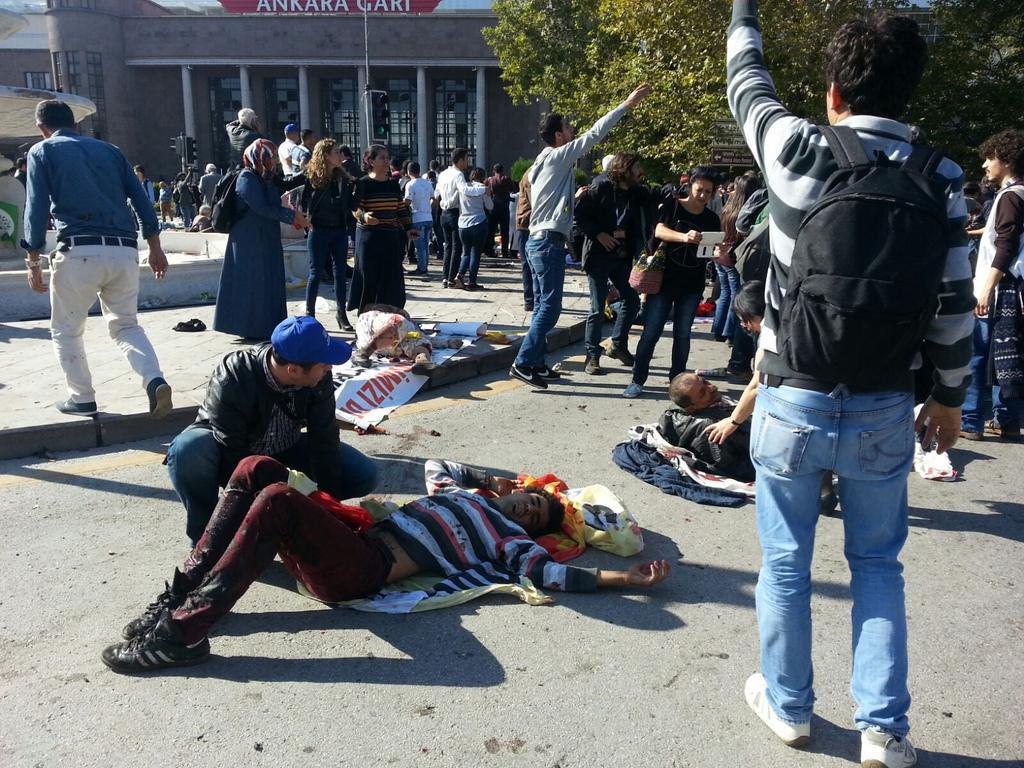
Powerful explosions kill dozens at peace rally in Ankara

Published time: 10 Oct, 2015 07:30Edited time: 10 Oct, 2015 20:33

A man helps an injured woman after an explosion during a peace march in Ankara, Turkey, October 10, 2015. © Recep Yilmaz / Reuters

2.7K2.2K12

Dozens of people have been killed and scores injured in two blasts at a peace rally in the Turkish capital, Ankara, officials said. According to the Turkish government, the explosions appeared to be the result of suicide bomb attacks.

The death toll from the tragedy has reached 95 people, the office of Turkish Prime Minister, Ahmet Davutoglu, said.
Earlier, Health Minister, Mehmet Muezzinoglu, said that at least 186 people have also been injured in the incident, with 28 of them in intensive care.

READ MORE: Deadly blasts rock Turkish capital LIVE UPDATES

According to local media, the explosion took place near Ankara Central railway station, the busiest in Turkey, which serves 181 trains daily. Several ambulances have been reportedly seen at the scene.

According to Lami Ozgen, head of the Confederation of Public Sector Trade Unions, or KESK, the bombs "exploded in very short intervals," AP reported.

The explosions occurred at a rally dubbed “Labor, Peace, Democracy” that kicked off at 10:00 local time (0700 GMT). Turkey's largest trade unions were planning to get together for a demonstration to protest the Turkish government’s renewed military campaign against Kurdish rebels.

Turkish Prime Minister Ahmet Davutoglu held a meeting with security officials following the tragedy, his office said.

"We are investigating the explosion and will share our findings with the public as soon as possible," a Turkish official told AFP.

Later, Davutoglu said the attack could have been carried out by Islamic State (IS, formerly ISIS/ISIL), Kurdish militants, or radical leftist groups.

“Since now ISIS is having hard times in Syria. Those fighters might be coming back to Turkey; might be planning more attacks in central location; in possibly touristic areas or in Istanbul, which is the economic capital of Turkey,” journalist Isil Sariyuce told RT.

Turkish President Tayyip Erdogan has commented on the attack, calling for "solidarity and determination as the most meaningful response to terror."

"Like other terror attacks, the one at the Ankara train station targets our unity, togetherness, brotherhood and future," he said. 

The hashtag #Ankaradayız (We are Ankara) has been used in 35,000 retweets in the hours since the attack.

Turkish labor unions, who were among the organizers of the peace rally, have called for a two-day strike from October 12 to 13 in response to the bombing.

Embedded image permalink

Thorbjørn Jagland, Secretary General of the Council of Europe, condemned the attack.

“The news from Ankara this morning is shocking and disturbing. This is a ruthless and barbaric attack on peaceful demonstrators. I express my condolences to all who have lost their friends and loved ones. Freedom of assembly and freedom of expression are fundamental pillars of democracy," he said.

Russian President Vladimir Putin has sent his condolences to Turkish President Tayyip Recep Erdogan over the Ankara tragedy, the Kremlin press service said in a statement.

In his telegram, Putin expressed the hope “that the perpetrators of this cynical crime would be brought to justice, and confirmed readiness for close cooperation with the Turkish authorities in the fight against the terrorist threat," the statement added.

Shortly after the attack, the Kurdistan Workers Party (PKK) announced it was planning to halt its activity in Turkey, a news website close to the PKK reported, as cited by Reuters.

Turkey's pro-Kurdish opposition Peoples' Democratic Party (HDP) claimed that their members were especially targeted in the deadly explosions.

"Just after the beginning of the march, at about 10:04 a.m., two bomb attacks occurred among the HDP cortege. For this reason, it is understood that the main target of the attacks was the HDP," the party said."Many of the injured people are heavily injured, so there is a fear that the number of dead people may increase."

HDP leader, Selahattin Demirtas, blamed the government for the attack, saying that it was part of Erdogan’s campaign against the Kurds. 

“The government’s right and chance to hum and haw has long expired. You are murderers. Your hand is bloody. Blood has splattered from your face, your mouth to your nails and all over you. You are the biggest supporters of terror,” Demirtas said, as cited by Reuters. 

PM Davutoglu refuted the accusations, calling them an “open provocation.”

No one has claimed responsibility for the terrorist attack, but it comes amid renewed fighting between Turkish security forces and Kurdish rebel forces.

READ MORE: At least 30 killed, 100 injured in 'terrorist attack' on Turkish town near Kobani

In July at least 30 people were killed and over 100 injured in an explosion that struck a cultural center in the town of Suruc, southeast Turkey, near the Syrian border, in what the authorities called a “terrorist attack.”

The Kurds have been fighting Turkish authorities for several decades, demanding an independent state or at least greater autonomy. The Turkish Kurds’ main insurgent group, the PKK, considered as a terrorist organization by Turkey, the US and NATO, was founded in 1978 and has been engaged in fighting with Turkey since 1984.

In September, the PKK claimed that its fighters had killed 15 Turkish soldiers in a surprise attack on an armored convoy.

READ MORE: 17 PKK members killed in Turkish military assault on Kurdish city of Silvan – reports

Earlier this month, Turkey mounted a military assault on the city of Silvan, which has a mainly Kurdish population, killing at least 17 militants.

Wednesday, October 7, 2015

The First Crack: Deutsche Bank Preannounces Massive Loss, May Cut Dividend

Tyler Durden's picture

Submitted by Tyler Durden on 10/07/2015 16:20 -0400

Amid numerous rumors that Deutsche Bank is among the corporations exposed to the VW fiasco, and to be clear there is no news to confirm that, DB has just kitchen-sinked it in a pre-announcement:

  • *DEUTSCHE BANK SEES 3Q NET LOSS EUR 6.2 BLN
  • *DEUTSCHE BANK TO RECOMMEND DIVIDEND CUT OR POSSIBLE ELIMINATION

Deutsche Bank stock is crashing down around 6% after-hours on the news.

*  *  *

Full Press release: Deutsche Bank expects to incur charges that will materially impact third quarter 2015 results:

An impairment of all goodwill and certain intangibles in Corporate Banking & Securities (CB&S) and Private & Business Clients (PBC) of approximately EUR 5.8 billion. This is largely driven by the impact of expected higher regulatory capital requirements on the measurement of the value of these segments as well as current expectations regarding the disposal of Postbank.

An impairment of the carrying value of Deutsche Bank's 19.99% stake in Hua Xia Bank Co. Ltd. of approximately EUR 0.6 billion. This reflects an updated valuation triggered by a change of the intent of the holding as Deutsche Bank no longer considers this stake to be strategic.

Litigation provisions of approximately EUR 1.2 billion, the majority of which are not expected to be tax deductible. Final litigation provisions in the quarter may be affected by further events before we finalize and report third quarter results.

The impairment of goodwill and intangibles and of the Hua Xia investment will have no significant impact on Deutsche Bank's regulatory capital ratios. Deutsche Bank currently expects to report a fully-loaded CRR/CRD4 Common Equity Tier 1 ratio for the third quarter of approximately 11%, which includes the impact of European Banking Authority Regulatory Technical Standards (\"Prudential Valuation\") that were adopted in the quarter.

Based on these charges, Deutsche Bank expects to report a third quarter income before income taxes (IBIT) loss of approximately EUR 6.0 billion and a net loss of EUR 6.2 billion. Year-to-date results through the third quarter are expected to be an IBIT loss of approximately EUR 3.3 billion and a net loss of EUR 4.8 billion.

Excluding the impact of the impairment of goodwill and intangibles, the third quarter IBIT loss would be approximately EUR 0.2 billion and the net loss would be approximately EUR 0.4 billion, largely reflecting the litigation provisions and Hua Xia impairment. On the same basis, Deutsche Bank expects to remain profitable year-to-date through the third quarter with IBIT of approximately EUR 2.5 billion and net income of approximately EUR 0.9 billion.

As part of the planning for the implementation of Strategy 2020, the Management Board will recommend a reduction or possible elimination of the Deutsche Bank common share dividend for the fiscal year of 2015.

All the aforementioned amounts are estimates. The final amounts will be determined in the coming weeks and will be disclosed in our announcement of  third quarter results, together with details of the implementation of  Strategy 2020, which is now scheduled to occur on October 29.

*  *  *

Is this the first crack (or the kitchen-sink'd last one?) As we asked previously, Is Deutsche Bank the next Lehman?

Submitted by NotQuant.com

Looking back at the Lehman Brothers collapse of 2008, it’s amazing how quickly it all happened.  In hindsight there were a few early-warning signs,  but the true scale of the disaster publicly unfolded only in the final moments before it became apparent that Lehman was doomed.

MI-CB391_PECK_G_20140218184730

First, for purposes of drawing a parallel, let’s re-cap the events of 2007-2008:

There were few early indicators of Lehman’s plight.   Insiders however, were well aware:   In late 2007, Goldman Sachs placed a massive proprietary bet against Lehman which would be known internally as the “Big Short”.  (It’s a bet that would later profit from during the crisis).

In the summer 2007 subprime loans were beginning to perform poorly in the marketplace.  By August of 2007, the commercial paper market saw liquidity evaporating quickly and funding for all types of asset-backed security was drying up.

But still — even in late 2007,  there was little public indication that Lehman was circling the drain.

Probably the first public indication that things were heading downhill for Lehman wasn’t until June 9th, 2008,  when Fitch Ratings cut Lehman’s rating to AA-minus, outlook negative. (ironically, 7 years to the day before S&P would cut DB)

The “negative outlook” indicates that another further downgrade is likely.   In this particular case, it was the understatement of all time.

A mere 3 months later, in the course of just one week,  Lehman would announce a major loss and file for bankruptcy.

article-2203390-1504DEE9000005DC-669_634x346

And the rest is history.

Could this happen to Deutsche Bank?

First, we must state the obvious:  If Deutsche Bank is the next Lehman, we will not know until events are moving at an uncontrollable and accelerating speed.   The nature of all fractional-reserve banks — who are by definition bankrupt at all times – is to project an aura of stability until that illusion has already begun to implode.

By the time we are aware of a crisis – if one is in the offing — it will already be a roaring blaze by the time it is known publicly.   It is by now well-established that truth is the first casualty of all banking crises.  There will be little in the way of early warnings.   To that end, we begin connecting the dots:

Here’s a re-cap of what’s happened at Deutsche Bank over the past 15 months:

  • In April of 2014,  Deutsche Bank was forced to raise an additional 1.5 Billion of Tier 1 capital to support it’s capital structure.  Why?
  • 1 month later in May of 2014, the scramble for liquidity continued as DB announced the selling of 8 billion euros worth of stock – at up to a 30% discount. Why again?  It was a move which raised eyebrows across the financial media.  The calm outward image of Deutsche Bank did not seem to reflect their rushed efforts to raise liquidity.  Something was decidedly rotten behind the curtain.
  • Fast forwarding to March of this year:   Deutsche Bank fails the banking industry’s “stress tests” and is given a stern warning to shore up it’s capital structure.
  • In April,  Deutsche Bank confirms it’s agreement to a joint settlement with the US and UK regarding the manipulation of LIBOR.   The bank is saddled with a massive $2.1 billion payment to the DOJ.  (Still, a small fraction of their winnings from the crime).
  • In May,  one of Deutsche Bank’s CEOs, Anshu Jain is given an enormous amount of new authority by the board of directors.  We guess that this is a “crisis move”.  In times of crisis the power of the executive is often increased.
  • June 5: Greece misses it’s payment to the IMF.   The risk of default across all of it’s debt is now considered acute.   This has massive implications for Deutsche Bank.
  • June 6/7:  (A Saturday/Sunday, and immediately following Greece’s missed payment to the IMF) Deutsche Bank’s two CEO’s announce their surprise departure from the company.  (Just one month after Jain is given his new expanded powers).   Anshu Jain will step down first at the end of June.  Jürgen Fitschen will step down next May.
  • June 9: S&P lowers the rating of Deutsche Bank to BBB+  Just three notches above “junk”.  (Incidentally,  BBB+ is even lower than Lehman’s downgrade – which preceded it’s collapse by just 3 months)

And that’s where we are now.  How bad is it?  We don’t know because we won’t be permitted to know.  But these are not the moves of a healthy company.

deutsche_ceos2

Jürgen Fitschen will step down May 2016. Jain will step down at the end of this month.

How exposed is Deutsche Bank?

The trouble for Deutsche Bank is that it’s conventional retail banking operations are not a significant profit center.  To maintain margins, Deutsche Bank has been forced into riskier asset classes than it’s peers.

Deutsche Bank is sitting on more than $75 Trillion in derivatives bets — an amount that is twenty times greater than German GDP.    Their derivatives exposure dwarfs even JP Morgan’s exposure –by a staggering $5 trillion.

With that kind of exposure, relatively small moves can precipitate catastrophic losses.   Again, we must note that Greece just missed it’s payment to the IMF – and further defaults are most certainly not beyond the realm of possibility.

Not good.

Not good.

And if the dominos were not adequately stacked already, there is one final domino which perfects the setup.

Meet Tom Humphrey.  He heads up Deutsche Bank’s Investment Banking operations on Wall Street.

He was also head of fixed income at Lehman.

Prior history.

Prior history.

History never repeats.   But it does rhyme.    In market terms, it tends to rhyme just about every 7 years.

* * *

For more read the Zero Hedge piece from April 2014: The Elephant In The Room: Deutsche Bank's $75 Trillion In Derivatives Is 20 Times Greater Than German GDP

Watch "Matt Drudge Visits the Alex Jones Show: Full Interview" on YouTube

Nelson Rockefeller Wanted Obamacare In 1954

Monday, October 5, 2015

Jail Those TPP Son's of Bitches

Obama Wants Your Guns, While Committing War Crimes In The Middle East

The Grand Canyon Gold and The Fed

Bix Weir
Printer-Friendly Format


Many people will find this interview is just too "out there" to be true but please listen with an open mind and follow the research where it leads you. This is amazing stuff when you think about it because it explains WHY and HOW we got here.

Note: I was just contacted by someone that knows first hand that there is a secret operation still going on in the Grand Canyon as he was "detained" in the 1960's while on a fishing expedition and was taken to a military base within the cordoned off area. He claims to have SEEN mining operations going on as well as some of the Egyptian artifacts. This source is more than credible to me and his description and detail of the area fits exactly with my analysis of what happened with the Fed in 1913.

Enjoy hearing one of the greatest secrets of all time!

More proof of the NY Times article and Golden Secrets here:

http://www.roadtoroota.com/public/181.cfm

May the Road you choose be the Right Road.

Bix Weir
www.RoadtoRoota.com

Sunday, October 4, 2015