Share

Monday, February 2, 2015

This Housing Chart Destroys The Arguments Of The Economic Optimists


Michael Snyder
Activist Post
Did you know that the rate of homeownership in the United States has fallen to a 20-year low?  Did you know that it has been falling consistently for an entire decade?
For the past couple of years, the economic optimists have been telling us that the economy has been getting better.  Well, if the economy really has been getting better, why does the homeownership rate keep going down?
Yes, the ultra-wealthy have received a temporary financial windfall thanks to the reckless money printing the Federal Reserve has been doing, but for most Americans economic conditions have not been improving.  This is clearly demonstrated by the housing chart that I am about to share with you.
If the economy really was healthy, more people would be getting good jobs and thus would be able to buy homes.  But instead, the homeownership rate has continued to plummet throughout the entire “Obama recovery”.  I think that this chart speaks for itself…

Homeownership Rate 2015

Of course this homeownership collapse began well before Barack Obama entered the White House.  Our economic problems are the result of decades of incredibly bad decisions.  But anyone that believes that things have “turned around” for the middle class under Barack Obama is just being delusional.

If the U.S. economy truly was in “good shape”, the percentage of Americans that own homes would not be at a 20 year low

The U.S. homeownership rate fell to the lowest in more than two decades in the fourth quarter as many would-be buyers stayed on the sidelines, giving the rental market a boost.
The share of Americans who own their homes was 64 percent in the fourth quarter, down from 64.4 percent in the previous three months, the Census Bureau said in a report. The rate was at the lowest since the second quarter of 1994, data compiled by Bloomberg show.
Rising prices and a tight supply of lower-end listings have put homes out of reach for some entry-level buyers, who also face strict mortgage standards. The share of U.S. homebuyers making their first purchase dropped in 2014 to the lowest level in almost three decades, the National Association of Realtors reported last week.
And it appears that this trend is actually accelerating.  During 2014, the rate of homeownership plummeted by a total of 1.2 percentage points for the year.  That was the largest one year decline that has ever been measured.
So why is this happening?
Well, in order to buy a home you have got to have a good job, and good jobs are in very short supply these days.
Over the past decade, the quality of the jobs in our economy has steadily declined as good jobs have been replaced by low paying jobs.  In addition, government policies are absolutely murdering small business.  At this point, small business ownership in the U.S. is hovering near record lows.
This has resulted in millions of people falling out of the middle class, and it has contributed to the growing divide between the wealthy and the rest of the country.
If our economy was working the way that it should, the middle class would be thriving.
But instead, it is being systematically destroyed.  If you doubt this, I have some statistics that I would like to share with you.  The following facts come from my previous article entitled "The Death Of The American Dream In 22 Numbers"…
#1 The Obama administration tells us that 8.69 million Americans are “officially unemployed” and that 92.90 million Americans are considered to be “not in the labor force”.  That means that more than 101 million U.S. adults do not have a job right now.
#2 One recent survey discovered that 55 percent of Americans believe that the American Dream either never existed or that it no longer exists.
#3 Considering the fact that Obama is in the White House, it is somewhat surprising that 55 percent of all Republicans still believe in the American Dream, but only 33 percent of all Democrats do.
#4 After adjusting for inflation, median household income has fallen by nearly $5,000 since 2007.
#5 After adjusting for inflation, “the median wealth figure for middle-income families” fell from $78,000 in 1983 to $63,800 in 2013.
#6 At this point, 59 percent of Americans believe that “the American dream has become impossible for most people to achieve”.
You can read the rest of that article right here.
The group that has been hit the hardest by all of this has been young adults.
Back in 2005, the homeownership rate for households headed up by someone under the age of 35 was approximately 43 percent.
Today, it has declined to about 35 percent.
From a very early age, we push our young people to go to college, and today more of them are getting secondary education than ever before.
But when they leave school, the “good jobs” that we promised them are often not there, and most of them end up entering the “real world” already loaded down with massive amounts of debt.
According to the Pew Research Center, close to four out of every ten households that are led by someone under the age of 40 are currently paying off student loan debt.
It is hard to believe, but total student loan debt in this country is now actually higher than total credit card debt.  At this point, student loan debt has reached a grand total of 1.2 trillion dollars, and that number has grown by an astounding 84 percent just since 2008.
If you are already burdened with tens of thousands (or in some cases hundreds of thousands) of dollars of debt when you get out of school and you can’t find a decent job, there is no way that you are going to be able to afford to buy a house.
So we have millions upon millions of young people that should be buying homes and starting families that are living with their parents instead.
Back in 1968, well over 50 percent of all Americans in the 18 to 31-year-old age bracket were already married and living on their own.
But today, that number is actually below 25 percent.  Instead, approximately 31 percent of all U.S. adults in the 18 to 34-year-old age bracket are currently living with their parents.
Something has fundamentally gone wrong.
Our economy is broken, and anyone that cannot see this is just being foolish.
So what is the solution?
Please feel free to share what you think by posting a comment below…
This article first appeared here at the Economic Collapse Blog.  Michael Snyder is a writer, speaker and activist who writes and edits his own blogs The American Dream and Economic Collapse Blog. Follow him on Twitter here.

This Housing Chart Destroys The Arguments Of The Economic Optimists
Activist
Mon, 02 Feb 2015 14:09:00 GMT

The Un-American Hero: The Crimes of John McCain


Brandon Turbeville
Activist Post
On Thursday January 29, 2015, famed mass murderer Henry Kissinger was once again scheduled to address the US Senate Armed Services Committee. Because the tradition of allowing some of the most bloodthirsty killers, traitors, and psychopaths to address members of Congress or provide them with marching orders is par for the course in Washington, Kissinger’s appearance should have come as no surprise to anyone.
Nor should it have come as a surprise that this committee boasted a terrorist sympathizer and notorious color revolution artist like John McCain as a member. What was surprising, however, was that this particular address saw a small number of protesters who disrupted the scheduled meeting both before and during Kissinger’s speech.
Both Kissinger’s arrival as well as the beginning of his speech were interrupted by protesters from Code Pink, who attempted to list off the crimes of Henry Kissinger but were unable to continue their presentation for the requisite number of days it would take to do so due to the fact that Capitol Hill police were called in to remove them.
It has been said that birds of a feather flock together and proof of that statement can be seen in the fact that terrorist sympathizer John McCain then appeared on his white horse to act as Knight in Shining Armor for Kissinger.
McCain, always a friend to those who have committed or are doing their best to commit atrocities on a mass scale, erupted in typical angry fashion screaming at protesters, “You know, you're going to have to shut up, or I'm going to have you arrested.” As the protesters were being removed, McCain also screamed, “Get out of here you low-life scum.”
McCain went on to apologize to Kissinger by stating that “Dr. Kissinger, I hope on behalf of all of the members of this committee on both sides of the aisle -- in fact, from all of my colleagues, I'd like to apologize for allowing such disgraceful behavior towards a man who served his country with the greatest distinction. I apologize profusely.”

Many Americans, particularly Vietnam veterans, however, may indeed remember “such disgraceful behavior towards a man who served his country with the greatest distinction” taking place in the Capitol. Indeed, John McCain’s performance in front of Congress when arguing against any further investigation or revelation of whether or not American POW’s were still being held in Vietnam, would certainly count as one such instance.
There was not only one of these performances, however, there were many.
McCain Dismisses Missing Military Personnel
As Sydney Schanburg wrote in his excellent article, “The War Secrets Sen. John McCain Hides,” McCain was consistent, at least in his actions, in his refusal to allow any further attempts to discover and recover missing American POWs in Vietnam as well as even the possibility of allowing any further investigation as to the possibility that Americans were still being held captive. This is, of course, despite McCain’s incessant reliance on his military service as some type of qualification for whatever his political position of the day might be.
As Schanburg writes,

But there was one subject that was off-limits, a subject the Arizona senator almost never brings up and has never been open about — his long-time opposition to releasing documents and information about American prisoners of war in Vietnam and the missing in action who have still not been accounted for. Since McCain himself, a downed Navy pilot, was a prisoner in Hanoi for 5 1/2 years, his staunch resistance to laying open the POW/MIA records has baffled colleagues and others who have followed his career.
Critics say his anti-disclosure campaign, in close cooperation with the Pentagon and the intelligence community, has been successful. Literally thousands of documents that would otherwise have been declassified long ago have been legislated into secrecy.
For example, all the Pentagon debriefings of the prisoners who returned from Vietnam are now classified and closed to the public under a statute enacted in the 1990s with McCain’s backing. He says this is to protect the privacy of former POWs and gives it as his reason for not making public his own debriefing.
[...]
Many Vietnam veterans and former POWs have fumed at McCain for keeping these and other wartime files sealed up. His explanation, offered freely in Senate hearings and floor speeches, is that no one has been proven still alive and that releasing the files would revive painful memories and cause needless emotional stress to former prisoners, their families and the families of MIAs still unaccounted for. But what if some of these returned prisoners, as has always been the case at the conclusion of wars, reveal information to their debriefing officers about other prisoners believed still held in captivity? What justification is there for filtering such information through the Pentagon rather than allowing access to source materials? For instance, debriefings from returning Korean war POWs, available in full to the American public, have provided both citizens and government investigators with important information about other Americans who went missing in that conflict.
Would not most families of missing men, no matter how emotionally drained, want to know? And would they not also want to know what the government was doing to rescue their husbands and sons? Hundreds of MIA families have for years been questioning if concern for their feelings is the real reason for the secrecy.
Others, however, suspect that all of McCain’s insistence in keeping the information classified revolves around whether or not releasing the debriefings would open the door to McCain’s closet, suggesting that there skeletons lurking inside it that the Senator does not want falling out. Schanburg writes,
A smaller number of former POWs, MIA families and veterans have suggested there is something especially damning about McCain that the senator wants to keep hidden. Without release of the files, such accusations must be viewed as unsubstantiated speculation. The main reason, however, for seeking these files is to find out if there is any information in the debriefings, or in other MIA documents that McCain and the Pentagon have kept sealed, about how many prisoners were held back by North Vietnam after the Paris peace treaty was signed in January 1973. The defense and intelligence establishment has long resisted the declassification of critical records on this subject. McCain has been the main congressional force behind this effort.
The prisoner return in 1973 saw 591 Americans repatriated by North Vietnam. The problem was that the U.S. intelligence list of men believed to be alive at that time in captivity — in Vietnam, Laos and possibly across the border in southern China and in the Soviet Union — was much larger.
Possibly hundreds of men larger. The State Department stated publicly in 1973 that intelligence data showed the prisoner list to be starkly incomplete. For example, only nine of the 591 returnees came out of Laos, though experts in U.S. military intelligence listed 311 men as missing in that Hanoi-run country alone, and their field reports indicated that many of those men were probably still alive. Hanoi said it was returning all the prisoners it had. President Nixon, on March 29, 1973, seconded that claim, telling the nation on television: “All of our American POWs are on their way home.” This discrepancy has never been acknowledged or explained by official Washington. Over the years in Washington, McCain, at times almost single-handedly, has pushed through Pentagon-desired legislation to make it impossible or much harder for the public to acquire POW/MIA information and much easier for the defense bureaucracy to keep it hidden.
Then there is also the case of the Truth Bill. A relatively simple bill which stated that
[The] head of each department or agency which holds or receives any records and information, including live-sighting reports, which have been correlated or possibly correlated to United States personnel listed as prisoner of war or missing in action from World War II, the Korean conflict and the Vietnam conflict shall make available to the public all such records and information held or received by that department or agency. In addition, the Department of Defense shall make available to the public with its records and information a complete listing of United States personnel classified as prisoner of war, missing in action, or killed in action (body not returned) from World War II, the Korean conflict, and the Vietnam conflict.
As one might suspect, a Pentagon implicated in the abandonment of these soldiers thus vehemently opposed the bill.
The bill was defeated in 1989. In 1991, it reappeared only to quickly disappear again. Although the interest from family members of the missing veterans as well as the American public had not necessarily waned, another bill was inserted in its place – The McCain Bill. As Schanburg describes,
This measure turned “The Truth Bill ” on its head. It created a bureaucratic maze from which only a fraction of the available documents could emerge. And it became law. So restrictive were its provisions that one clause actually said the Pentagon didn’t even have to inform the public when it received intelligence that Americans were alive in captivity.
First, it decreed that only three categories of information could be released, i.e., “information … that may pertain to the location, treatment, or condition of” unaccounted-for personnel from the Vietnam War. (This was later amended in 1995 and 1996 to include the Cold War and the Korean conflict.) If information is received about anything other than “location, treatment or condition,” under this statute, which was enacted in December 1991, it does not get disclosed.
Second, before such information can be released to the public, permission must be granted by the primary next of kin, or PNOK. In the case of Vietnam, letters were sent by the Department of Defense to the 2,266 PNOK. More than 600 declined consent (including 243 who failed to respond, considered under the law to be a “no”).
[...]
Finally, in addition to these hurdles and limitations, the McCain act does not specifically order the declassification of the information. Further, it provides the Defense Department with other justifications for withholding documents. One such clause says that if the information “may compromise the safety of any United States personnel … who remain not accounted for but who may still be alive in captivity, then the Secretary [of Defense] may withhold that record or other information from the disclosure otherwise required by this section.”
Boiled down, the preceding paragraph means that the Defense Department is not obligated to tell the public about prisoners believed alive in captivity and what efforts are being made to rescue them. It only has to notify the White House and the intelligence committees in the Senate and House. The committees are forbidden under law from releasing such information.
At the same time, the McCain act is now being used to deny access to other sorts of records. For instance, part of a recent APBnews.com Freedom of Information Act request for the records of a mutiny on merchant marine vessel in the 1970s was rejected by a Defense Department official who cited the McCain act. Similarly, requests for information about Americans missing in the Korean War and declared dead for the last 45 years have been denied by officials who reference the McCain statute.
In 1996, however, another bill appeared. Entitled the Missing Service Personnel Act, the bill attempted to force the Pentagon to do more and act faster to find and subsequently recover missing military service personnel. The bill contained measures that required very strict reporting requirements for these purposes.
Schanburg describes how McCain once again rode into town to destroy any potential that may have existed to discover existing missing personnel or any personnel who might become missing in the future. He writes,
McCain amended the heart out of the statute. For example, the 1995 version required a unit commander to report to his theater commander within two days that a person was missing and describe what rescue and recovery efforts were underway. The McCain amendments allowed 10 days to pass before a report had to be made.
In the 1995 act, the theater commander, after receiving the MIA report, would have 14 days to report to his Cabinet secretary in Washington. His report had to “certify” that all necessary actions were being taken and all appropriate assets were being used “to resolve the status of the missing person.” This section was stricken from the act, replaced with language that made the Cabinet secretary, not the theater commander, the recipient of the report from the field. All the certification requirements also were stricken.
[...]
In response, the backers of the original statute cited the Pentagon’s stained record on MIA’s and argued that military history had shown that speed of action is critical to the chances of recovering a missing man. Moving “the bureaucracy ” to Washington, they said, was merely a way to sweep the issue under a rug.
One final evisceration in the law was McCain’s removal of all its enforcement teeth. The original act provided for criminal penalties for anyone, such as military bureaucrats in Washington, who destroy or cover up or withhold from families any information about a missing man. McCain erased this part of the law. He said the penalties would have a chilling effect on the Pentagon’s ability to recruit personnel for its POW/MIA office.
Schanburg points out how McCain has personally acted as the first line of defense against any who may suggest that POWs were left to their fate in Vietnam. McCain acts, on this issue especially, behind a carefully crafted but false veneer of patriotism and military service that appears to make him infallible in the eyes of many low information voters.
Schanburg writes,
McCain does not deal lightly with those who disagree with him on any of these issues or who suggest that the evidence indeed shows that a significant number of prisoners were alive and cached away as future bargaining chips when he came home in the group of 591 released in 1973.
Over the years, he has regularly vilified any group or person who keeps trying to pry out more evidence about MIAs. He calls them “hoaxers” and “charlatans ” and “conspiracy theorists.” He decries the “bizarre rantings of the MIA hobbyists” and describes them as “individuals primarily who make their living off of keeping the issue alive.” Before he died last year of leukemia, retired Col. Ted Guy, a highly admired POW and one of the most dogged resisters in the camps, wrote an angry open letter to the senator in an MIA newsletter. In it, he said of McCain’s stream of insults: “John, does this include Senator Bob Smith and other concerned elected officials? Does this include the families of the missing where there is overwhelming evidence that their loved ones were ‘last known alive? ’ Does this include some of your fellow POWs?”
Clearly, McCain likes dissent the way he likes his veterans – silent. This silence, for McCain, can come by any means necessary.
Indeed, McCain has been the biggest denier of all when it comes to the possibility that American soldiers were left on the battlefield. Schanburg states,
McCain has said again and again that he has seen no “credible” evidence that more than a tiny handful of men might have been alive in captivity after the official prison return in 1973. He dismisses all of the subsequent radio intercepts, live sightings, satellite photos, CIA reports, defector information, recovered enemy documents and reports of ransom demands — thousands and thousands of pieces of information indicating live captives — as meaningless. He has even described these intelligence reports as the rough equivalent of UFO and alien sightings.
In Congress, colleagues and staffers who have seen him erupt — in the open and, more often, in closed meetings — profess themselves confounded by his behavior. Insisting upon anonymity so as not to invite one of his verbal assaults, they say they have no easy way to explain why a former POW would work so hard and so persistently to keep POW/MIA information from coming out. Typical is the comment of one congressional veteran who has watched McCain over many years: “This is a man not at peace with himself.”
Some McCain watchers searching for answers point to his recently published best-selling autobiography, Faith of My Fathers, half of which is devoted to his years as a prisoner. In the book, he says he felt badly throughout his captivity because he knew he was being treated more leniently than his fellow POWs owing to his propaganda value as the son of Adm. John S. McCain II, who was then the CINCPAC — commander in chief of all U.S. forces in the Pacific region, including Vietnam. (His captors considered him a prize catch and nicknamed him the “Crown Prince.”)
Also in the book, the Arizona Senator repeatedly expresses guilt and disgrace at having broken under torture and given the North Vietnamese a taped confession, broadcast over the camp loudspeakers, saying he was a war criminal who had, among other acts, bombed a school. “I felt faithless and couldn’t control my despair,” he writes. He writes, revealing that he made two half-hearted attempts at suicide. Most tellingly, he said he lived in “dread” that his father would find out. “I still wince,” he says, “when I recall wondering if my father had heard of my disgrace.”
[...]
But how would McCain’s forced confession alone explain his endless campaign against releasing MIA/POW information?
Some veterans and other McCain watchers have speculated that McCain’s mortification, given his family’s proud military tradition (his grandfather was also an admiral), was so severe that it continues to haunt him and make him fear any opening up of information that could revive previously unpublished details of the era, including his own nagging history.
McCain’s nagging problem – at least while surviving Vietnam veterans and/or their family members were more prevalent than they are today – was the fact that there were actual witnesses to the evidence pointing toward the existence of American POWs in Vietnam.
Schanburg writes about the case of Dolores Apodaca Alfond, Chairwoman of the National Alliance of Families. He states,
Her pilot brother, Capt. Victor J. Apodaca, out of the Air Force Academy, was shot down over Dong Hoi, North Vietnam, in the early evening of June 8, 1967. At least one person in the two-man plane survived. Beeper signals from a pilot’s distress radio were picked up by overhead helicopters, but the cloud cover was too heavy to go in. Hanoi has recently turned over some bone fragments that are supposed to be Apodaca’s. The Pentagon first declared the fragments to be animal bones. But now it is telling the family — verbally — that they came from the pilot. But the Pentagon, for unexplained reasons, will not put this in writing, which means Apodaca is still unaccounted for. Also the Pentagon refuses to give Alfond a sample of the fragments so she can have testing done by an independent laboratory.
Alfond’s testimony, at a hearing of the POW/MIA committee Nov. 11, 1992, was revealing. She pleaded with the committee not to shut down in two months, as scheduled, because so much of its work was unfinished. Also, she was critical of the committee, and in particular Kerry and McCain, for having “discredited the overhead satellite symbol pictures, arguing there is no way to be sure that the [distress] symbols were made by U.S. POWs.” She also criticized them for similarly discounting data from special sensors, shaped like a large spike with an electronic pod and an antenna, that were airdropped to stick in the ground along the Ho Chi Minh trail.
[...]
Other than the panel’s second co-chairman, Sen. Bob Smith, R-N.H., not a single committee member attended this public hearing. But McCain, having been advised of Alfond’s testimony, suddenly rushed into the room to confront her. His face angry and his voice very loud, he accused her of making “allegations … that are patently and totally false and deceptive.” Making a fist, he shook his index finger at her and said she had insulted an emissary to Vietnam sent by President Bush. He said she had insulted other MIA families with her remarks. And then he said, through clenched teeth: “And I am sick and tired of you insulting mine and other people’s [patriotism] who happen to have different views than yours.”
By this time, tears were running down Alfond’s cheeks. She reached into her handbag for a handkerchief. She tried to speak: “The family members have been waiting for years — years! And now you’re shutting down.” He kept interrupting her. She tried to say, through tears, that she had issued no insults. He kept talking over her words. He said she was accusing him and others of “some conspiracy without proof, and some cover-up.” She said she was merely seeking “some answers. That is what I am asking.” He ripped into her for using the word “fiasco.” She replied: “The fiasco was the people that stepped out and said we have written the end, the final chapter to Vietnam.” “No one said that,” he shouted. “No one said what you are saying they said, Ms. Alfond.” And then, his face flaming pink, he stalked out of the room, to shouts of disfavor from members of the audience.
As with most of McCain’s remarks to Alfond, the facts in his closing blast at her were incorrect. Less than three weeks earlier, on Oct. 23, 1992, in a ceremony in the White House Rose Garden, President Bush — with John McCain standing beside him — said: “Today, finally, I am convinced that we can begin writing the last chapter in the Vietnam War.”
The committee did indeed, as Alfond said they planned to do, shut down two months after the hearing.
Schanburg is no “conspiracy theorist,” it should be noted. He is a Pulitzer Prize winner from 1975 whose coverage of the social and political situation in Cambodia won him the award. Indeed, it was Schanburg’s work that laid the basis for the movie The Killing Fields.
McCain’s Support For ISIS
Yet McCain’s treachery regarding missing US military service personnel is not the only crime of his career by any stretch of the imagination. On the Sean Hannity Show, when responding to some tepid criticism by Rand Paul regarding the methods taken to support Western-backed jihadist death squads in Syria, McCain stated,
Has Rand Paul ever been to Syria? Has he ever met with ISIS? Has he ever met with any of these people? No. No. We’re gonna have a fight because it’s patently false. This is the same Rand Paul that said we didn’t want to have anything to do with anything by the way. I don’t want to get in a fight with him at all. But it’s not true. I know these people. I’m in contact with them all the time and he is not.
Earlier in the interview, after stating that he could personally show Obama places on the map to bomb in Syria to kill ISIS, he also stated that, in regards to the death squads, “I know these people intimately. We talk to them all the time.”
McCain’s also referred back to the tired line of Syrian death squads actually being peaceful protesters “fighting for freedom.”
Indeed, of those who provide material support to terrorism, John McCain would obviously rank at the top of the list. After all, John McCain led the charge in support of ISIS even before the terrorist group actually was called ISIS. Even after the new name and the brutality of its terrorist acts were revealed, John McCain has continued to push the outlandish lie that ISIS is a better choice than the secular government of Bashar al-Assad. He has also pushed for the U.S. Congress to support acting as Al-Qaeda’s Air Force in Syria.
It is important to note that even as the U.S. House was debating whether or not to pass token legislation to passively allow the Obama administration to perpetrate yet another foreign war against a sovereign nation that poses no threat to the United States, rabid warmonger John McCain was grilling Secretary of State John Kerry in what amounted to nothing more than some mildly entertaining D.C. theatre.
McCain grilled Kerry on the reason why the United States is not engaging in airstrikes against Assad’s air defenses as well as a full-scale ground invasion. Attempting to somehow paint Assad as worse than ISIS, McCain stated,
I think at least we owe the Free Syrian Army, negate the air attacks that they will be subjected to when they finish their training and equipping, and go into the fight. So why is it that we won’t at least news release Bashar al Assad’s air activity which has slaughtered thousands and thousands and thousands, 192,000 dead, 3 million refugees, and we’re not going to do anything about Assad’s air capabilities? And finally, ISIL first, that’s what you’re telling these young men who really view Assad as the one who has slaughtered their family members. Not ISIL. As bad as ISIL is.
Yet while his ideology may not be a crime, actually meeting and coordinating with Al-Qaeda most certainly is. In this regard, McCain has overwhelmingly demonstrated his guilt, having been caught in a number of photographs with the leader of death squad battalions, cannibals, and even the leader of al-Qaeda/ISIS himself.
McCain’s photo-op in Syria is a very interesting case since members of the general public are still considered as guilty of “providing material support” to terrorists if they engage in the same activities.
Regardless, Salem Idriss, one of the men seen in the photograph with John McCain, is the commander of the FSA, the “opposition group” touted as a “moderate rebels.” In reality, of course, the FSA is nothing of the sort. As Daniel Wagner wrote for the Huffington Post in December, 2012,
In the outskirts of Aleppo, the FSA has implemented a Sharia law enforcement police force that is a replica of the Wahhabi police in Saudi Arabia -- forcing ordinary citizens to abide by the Sharia code. This is being done in a secular country which has never known Sharia Law. This type of action is currently also being implemented in northern Mali, where the West has officially declared its opposition to the al-Qaeda government that took control earlier this year. If what is happening near Aleppo is representative of what may happen if the FSA assumes control of Syria, the country may become an Islamic state. Is that really what the U.S. and other Western countries are intending to tacitly support?
[...]
The FSA has also been targeting the infrastructure of the country. One of the main power plants in Damascus was knocked out for three days last week, impacting 40 percent of the city's residents. Do 'freedom fighters' typically attack critical infrastructure that impacts ordinary citizens on a mass scale? The FSA long ago stopped targeting solely government and military targets.
The FSA is no stranger to atrocities. The FSA is the “moderate opposition” that was filmed forcing a young child to behead a Syrian soldier. It is also the “moderate opposition” that maintained “burial brigades,” a system of mass murder and mass executions against soldiers and those who support the Syrian government. The burial brigades were only one small part of a much wider campaign of terror and executions implemented by the Free Syrian Army.
Of course, the Free Syrian Army is merely the umbrella group of death squads carefully crafted to present a “moderate” face on what is, in reality, nothing more than savage terrorists. Thus, the FSA encompasses(d) a number of smaller “brigades” of al-Qaeda terrorists in order to cover up the true nature of its own ranks.
One such brigade was the Farouq brigade, to which Abu Sakkar was a member. Sakkar, also seen in photographs with John McCain, was the famous rebel videotaped cutting the heart out of a Syrian soldier and biting into it.
Abu Bakr al-Baghdadi, another one of McCain’s pic-mates, is now the leader of IS (ISIS/ISIL) and was the leader of al-Qaeda forces at the time that the photograph was taken. As Voltaire Net describes Baghdadi,
Abu Bakr al-Baghdadi is an Iraqi who joined Al-Qaeda to fight against President Saddam Hussein. During the U.S. invasion, he distinguished himself by engaging in several actions against Shiites and Christians (including the taking of the Baghdad Cathedral) and by ushering in an Islamist reign of terror (he presided over an Islamic court which sentenced many Iraqis to be slaughtered in public). After the departure of Paul Bremer III, al-Baghdadi was arrested and incarcerated at Camp Bucca from 2005 to 2009. This period saw the dissolution of Al-Qaeda in Iraq, whose fighters merged into a group of tribal resistance, the Islamic Emirate of Iraq.
On 16 May 2010, Abu Bakr al-Baghdadi was named emir of the IEI, which was in the process of disintegration. After the departure of U.S. troops, he staged operations against the government al-Maliki, accused of being at the service of Iran. In 2013, after vowing allegiance to Al-Qaeda, he took off with his group to continue the jihad in Syria, rebaptizing it Islamic Emirate of Iraq and the Levant. In doing so, he challenged the privileges that Ayman al-Zawahiri had previously granted, on behalf of Al-Qaeda, to the Al-Nusra Front in Syria, which was originally nothing more than an extension of the ISI.
Note that at no time was Baghdadi a “moderate rebel” in any context. Nor was he ever anything more than a puppet for Western intelligence agencies.
So McCain has met with at least three terrorists and terrorist organizations in Syria. But these groups are by no means the end of the trail of McCain’s treachery or his connection to terrorism. After all, it must be remembered that McCain traveled to Libya during the assault against Ghaddafi in order to meet with terrorists in that country and promote the barbarism which they would ultimately bring. As Tony Cartalucci writes in his article, “John McCain Claims Al-Qaeda Thugs Have ‘Inspired The World,’”
He [McCain] had made an April visit to Benghazi, a city cited along with neighboring Darnah by a 2007 West Point report as the terror recruiting capitals of the world and the primary sources of foreign fighters that made their way to Iraq fighting and killing American troops. These fighters did so under the flag of the Libyan Islamic Fighting Group (LIFG), listed to this day by the US State Department as a "foreign terrorist organization." Despite overwhelming evidence and even admissions from Libyan rebels themselves of having ties to, being members of, or in Tripoli "council leader" Abdul Belhaj's case, a leader of this listed terrorist organization, McCain would declare he had "met with these brave fighters, and they are not Al-Qaeda. To the contrary: They are Libyan patriots who want to liberate their nation."
Despite McCain's reassuring words, the rebels over the next several months would increasingly reveal their true nature to a horrified world as they waged racist genocide against Libya's darker and black tribes, and conducted their "liberation" against cities resisting them with indiscriminate heavy weapons, blockades designed to literally starve the populations into submission and horrific reprisals once cities fell. While the corporate media did its best to obfuscate these atrocities, when entire cities like Tawarga with its 10,000 residents began disappearing from the map, even the propagandists were forced to acknowledge the "liberators" were less than noble.
It should also be noted that McCain is extremely close to the color revolution apparatus organization, the International Republican Institute, a wing of the National Endowment for Democracy and USAID. In fact, he is the current Chairman of the IRI.
As it currently stands, the fact that some people are more equal than others is clearly proven in the case of John McCain. While any other American would be immediately imprisoned and possibly tortured as a result of their connections to terrorism, John McCain is rewarded with the title of U.S. Senator and the false label of “war hero.”
It is thus important for every American to know that not only is there no such thing as a moderate opposition in Syria but that John McCain is no American hero. If the Americans mentioned in the recent AP report can be investigated, tried, and convicted of providing support for terrorists operating abroad then surely John McCain has earned his day in court.
McCain And The Nazis
Yet another stop on his world tour of destabilization and incitement to war crimes was Kiev, where McCain was photographed standing next to neo-Nazi Oleh Tyahnybok, the leader of the nationalist and neo-nazi Svoboda party.
As Tony Cartalucci reported in his article “US Sponsored Democracy: A Tale of Two Protests. Ukraine and Thailand,”
Along with other racist, bigoted, extremist political parties including “Fatherland,” Svoboda has filled the streets, clashed with police, occupied government buildings and called for the overthrow of the elected government of Ukraine – for the sake of joining the European Union. The EU, for its part, awaits these mobs with open arms.
Joining the EU in anticipation is US Senator John McCain of the US National Endowment for Democracy’s (NED) International Republican Institute. McCain went as far as traveling to Kiev, Ukraine, and even taking to the stage at the protest – side-by-side with Svoboda leader Oleh Tyahnybok.
Of Svoboda, the Business Insider would have this to say in their article titled, “John McCain Went To Ukraine And Stood On Stage With A Man Accused Of Being An Anti-Semitic Neo-Nazi:”
Svoboda (which means freedom in Ukrainian) is one of those reconstructed modern European far right parties — it is aligned with the British National Party and the French National Front, for example — and it has gained some kind of electoral legitimacy, winning 10 percent of the seats in Ukraine’s parliament in 2010.
However, the party’s past is seriously murky. When it was founded in 1995, the party called itself the Social-National Party of Ukraine (SNPU), and it had a swastika-like logo. While it eventually split from its more right wing members, the party remained focused on celebrating Ukrainian ethnic identity in opposition to Russia and Communism.
Tyahnybok himself was expelled from the Our Ukraine parliamentary faction in 2004 after giving a speech demanding that Ukrainians fight against a ”Muscovite-Jewish mafia” (he later clarified this by saying that he actually had Jewish friends and was only against to “a group of Jewish oligarchs who control Ukraine and against Jewish-Bolsheviks [in the past]“). In 2005 he wrote open letters demanding Ukraine do more to halt “criminal activities” of “organized Jewry,” and, even now, Svoboda openly calls for Ukrainian citizens to have their ethnicity printed onto their passports.
One could scarcely imagine what justification John McCain could give for associating with literal Nazis. But one will have to be satisfied with only imagining, since the Western media, charged with seeking the truth, has not raised this question let alone answered it. Even the Business Insider attempts to give McCain the benefit of the doubt in order to allow the protests to continue and to allow the US, UK, and EU to continue openly supporting them.
Conclusion
The fact that John McCain is represented as an expert or, even worse, a hero by any mainstream media outlet is a slap in the face to all basic common sense. The facts surrounding this man show him placing American service men and women in harm’s way on almost innumerable occasions while simultaneously working to stab them in the back by ensuring that those who are missing in action are forgotten or even working closely with the individuals and organizations who are supposedly the enemy of the United States.
This is of no concern to McCain of course, who, like his friend Henry Kissinger, believes that military personnel are just “dumb stupid animals to be used for foreign policy.”
Obviously, GI John is no American hero.
Recently from Brandon Turbeville: Brandon Turbeville is an author out of Florence, South Carolina. He has a Bachelor's Degree from Francis Marion University and is the author of six books, Codex Alimentarius -- The End of Health Freedom, 7 Real Conspiracies, Five Sense Solutions and Dispatches From a Dissident, volume 1 and volume 2, and The Road to Damascus: The Anglo-American Assault on Syria. Turbeville has published over 300 articles dealing on a wide variety of subjects including health, economics, government corruption, and civil liberties. Brandon Turbeville's podcast Truth on The Tracks can be found every Monday night 9 pm EST at UCYTV.  He is available for radio and TV interviews. Please contact activistpost (at) gmail.com.

The Un-American Hero: The Crimes of John McCain
Admin
Mon, 02 Feb 2015 16:50:00 GMT

Exclusive: Secret tapes undermine Hillary Clinton on Libyan war

Joint Chiefs, key lawmaker held own talks with Moammar Gadhafi regime
By Jeffrey Scott Shapiro and Kelly Riddell - The Washington Times - Wednesday, January 28, 2015

First of three parts - See link at the end to hear secret tapes


Top Pentagon Officals and a Senior Democrat in Congress so distrusted Secretary of State Hillary Rodham Clinton’s 2011 march to war in Libya that they opened their own diplomatic channels with the Gadhafi regime in an effort to halt the escalating crisis, according to secret audio recordings recovered from Tripoli.

The tapes, reviewed by The Washington Times and authenticated by the participants, chronicle U.S. officials’ unfiltered conversations with Col. Moammar Gadhafi’s son and a top Libyan leader, including criticisms that Mrs. Clinton had developed tunnel vision and led the U.S. into an unnecessary war without adequately weighing the intelligence community’s concerns.

“You should see these internal State Department reports that are produced in the State Department that go out to the Congress. They’re just full of stupid, stupid facts,” an American intermediary specifically dispatched by the Joint Chiefs of Staff told the Gadhafi regime in July 2011, saying the State Department was controlling what intelligence would be reported to U.S. officials.

At the time, the Gadhafi regime was fighting a civil war that grew out of the Arab Spring, battling Islamist-backed rebels who wanted to dethrone the longtime dictator. Mrs. Clinton argued that Gadhafi might engage in genocide and create a humanitarian crisis and ultimately persuaded President Obama, NATO allies and the United Nations to authorize military intervention.


Losing control: Col. Moammar Gadhafi ruled Libya with an iron fist, but ...more >

Gadhafi’s son and heir apparent, Seif Gadhafi, told American officials in the secret conversations that he was worried Mrs. Clinton was using false pretenses to justify unseating his father and insisted that the regime had no intention of harming a mass of civilians. He compared Mrs. Clinton’s campaign for war to that of the George W. Bush administration’s now debunked weapons of mass destruction accusations, which were used to lobby Congress to invade Iraq, the tapes show.

SEE ALSO: Listen to the tapes: Intel undercuts Hillary Clinton’s primary argument for Libya military action

“It was like the WMDs in Iraq. It was based on a false report,” Gadhafi said in a May 2011 phone call to Rep. Dennis J. Kucinich, an Ohio Democrat serving at the time. “Libyan airplanes bombing demonstrators, Libyan airplanes bombing districts in Tripoli, Libyan army killed thousands, etc., etc., and now the whole world found there is no single evidence that such things happened in Libya.”

Seif Gadhafi also warned that many of the U.S.-supported armed rebels were “not freedom fighters” but rather jihadists whom he described as “gangsters and terrorists.”

“And now you have NATO supporting them with ships, with airplanes, helicopters, arms, training, communication,” he said in one recorded conversation with U.S. officials. “We ask the American government send a fact-finding mission to Libya. I want you to see everything with your own eyes.”

The surreptitiously taped conversations reveal an extraordinary departure from traditional policy, in which the U.S. government speaks to foreign governments with one voice coordinated by the State Department.

Instead, the tapes show that the Pentagon’s senior uniformed leadership and a congressman from Mrs. Clinton’s own party conveyed sentiments to the Libyan regime that undercut or conflicted with the secretary of state’s own message at the time.

“If this story is true, it would be highly unusual for the Pentagon to conduct a separate set of diplomatic negotiations, given the way we operated when I was secretary of state,” James A. Baker III, who served under President George H.W. Bush, told The Times. “In our administration, the president made sure that we all sang from the same hymnal.”

Mr. Kucinich, who challenged Mrs. Clinton and Barack Obama for the 2008 Democratic presidential nomination, acknowledged that he undertook his own conversations with the Gadhafi regime. He said he feared Mrs. Clinton was using emotion to sell a war against Libya that wasn’t warranted, and he wanted to get all the information he could to share with his congressional colleagues.

“I had facts that indicated America was headed once again into an intervention that was going to be disastrous,” Mr. Kucinich told The Times. “What was being said at the State Department — if you look at the charge at the time — it wasn’t so much about what happened as it was about what would happen. So there was a distortion of events that were occurring in Libya to justify an intervention which was essentially wrong and illegal.”

Mr. Kucinich wrote a letter to Mr. Obama and Mrs. Clinton in August explaining his communications in a last-ditch effort to stop the war.

“I have been contacted by an intermediary in Libya who has indicated that President Muammar Gadhafi is willing to negotiate an end to the conflict under conditions which would seem to favor Administration policy,” Mr. Kucinich wrote on Aug. 24.

Neither the White House nor the State Department responded to his letter, he said.

A spokesman for Mrs. Clinton declined to provide any comment about the recordings.

The State Department also declined to answer questions about separate contacts from the Pentagon and Mr. Kucinich with the Gadhafi regime, but said the goal of Mrs. Clinton and Mr. Obama was regime change in Libya.

“U.S. policy during the revolution supported regime change through peaceful means, in line with UNSCR 1973 policy and NATO mission goals,” the State Department said. “We consistently emphasized at the time that Moammar Gadhafi had to step down and leave Libya as an essential component of the transition.”

‘President is not getting accurate information’

Both inside and outside the Obama administration, Mrs. Clinton was among the most vocal early proponents of using U.S. military force to unseat Gadhafi. Joining her in making the case were French President Nicolas Sarkozy, Sen. John McCain, Arizona Republican, and her successor as secretary of state, John F. Kerry.

Mrs. Clinton’s main argument was that Gadhafi was about to engage in a genocide against civilians in Benghazi, where the rebels held their center of power. But defense intelligence officials could not corroborate those concerns and in fact assessed that Gadhafi was unlikely to risk world outrage by inflicting mass casualties, officials told The Times. As a result, Defense Secretary Robert M. Gates and Adm. Mike Mullen, chairman of the Joint Chiefs of Staff, strongly opposed Mrs. Clinton’s recommendation to use force.

If Mrs. Clinton runs for president next year, her style of leadership as it relates to foreign policy will be viewed through the one war that she personally championed as secretary of state. Among the key questions every candidate faces is how they will assess U.S. intelligence and solicit the advice of the military leadership.

Numerous U.S. officials interviewed by The Times confirmed that Mrs. Clinton, and not Mr. Obama, led the charge to use NATO military force to unseat Gadhafi as Libya’s leader and that she repeatedly dismissed the warnings offered by career military and intelligence officials.

In the recovered recordings, a U.S. intelligence liaison working for the Pentagon told a Gadhafi aide that Mr. Obama privately informed members of Congress that Libya “is all Secretary Clinton’s matter” and that the nation’s highest-ranking generals were concerned that the president was being misinformed.

The Pentagon liaison indicated on the tapes that Army Gen. Charles H. Jacoby Jr., a top aide to Adm. Mullen, “does not trust the reports that are coming out of the State Department and CIA, but there’s nothing he can do about it.”

In one conversation to the Libyans, the American intelligence asset said, “I can tell you that the president is not getting accurate information, so at some point someone has to get accurate information to him. I think about a way through former Secretary Gates or maybe to Adm. Mullen to get him information”

The recordings are consistent with what many high-ranking intelligence, military and academic sources told The Times:

Mrs. Clinton was headstrong to enter the Libyan crisis, ignoring the Pentagon’s warnings that no U.S. interests were at stake and regional stability could be threatened. Instead, she relied heavily on the assurances of the Libyan rebels and her own memory of Rwanda, where U.S. inaction may have led to the genocide of at least 500,000 people.

“Neither the intervention decision nor the regime change decision was an intelligence-heavy decision,” said one senior intelligence official directly involved with the administration’s decision-making, who spoke on the condition of anonymity. “People weren’t on the edge of their seats, intelligence wasn’t driving the decision one way or another.”

Instead of relying on the Defense Department or the intelligence community for analysis, officials told The Times, the White House trusted Mrs. Clinton’s charge, which was then supported by Ambassador to the United Nations Susan E. Rice and National Security Council member Samantha Power, as reason enough for war.

“Susan Rice was involved in the Rwanda crisis in 1994, Samantha Power wrote very moving books about what happened in Rwanda, and Hillary Clinton was also in the background of that crisis as well,” said Allen Lynch, a professor of international relations at the University of Virginia. “I think they have all carried this with them as a kind of guilt complex.”

Humanitarian crisis was not imminent

In 2003, Gadhafi agreed to dismantle his weapons of mass destruction and denounce terrorism to re-establish relations with the West. He later made reparations to the families of those who died in the bombing of Pan-Am Flight 103 over Lockerbie, Scotland.

News media frequently described the apparent transformation as Libya “coming in from the cold.”

Still, he ruled Libya with an iron grip, and by February 2011 civil war raged throughout the country. Loyalist forces mobilized tanks and troops toward Benghazi, creating a panicked mass exodus of civilians toward Egypt.

Mrs. Clinton met with Libyan rebel spokesman Mahmoud Jibril in the Paris Westin hotel in mid-March so she could vet the rebel cause to unseat Gadhafi. Forty-five minutes after speaking with Mr. Jibril, Mrs. Clinton was convinced that a military intervention was needed.

“I talked extensively about the dreams of a democratic civil state where all Libyans are equal a political participatory system with no exclusions of any Libyans, even the followers of Gadhafi who did not commit crimes against the Libyan people, and how the international community should protect civilians from a possible genocide like the one [that] took place in Rwanda,” Mr. Jibril told The Times. “I felt by the end of the meeting, I passed the test. Benghazi was saved.”

So on March 17, 2011, the U.S. supported U.N. Security Council Resolution 1973 for military intervention in Libya to help protect its people from Gadhafi’s forthcoming march on Benghazi, where he threatened he would “show no mercy” to resisters.

“In this particular country — Libya — at this particular moment, we were faced with the prospect of violence on a horrific scale,” Mr. Obama declared in an address to the nation on March 28. “We had a unique ability to stop that violence: An international mandate for action, a broad coalition prepared to join us, the support of Arab countries and a plea for help from the Libyan people themselves.”

Yet Human Rights Watch did not see the humanitarian crisis as imminent.

“At that point, we did not see the imminence of massacres that would rise to genocidelike levels,” said Sarah Leah Whitson, executive director of the Middle East and North Africa division for Human Rights Watch. “Gadhafi’s forces killed hundreds of overwhelmingly unarmed protesters. There were threats of Libyan forces approaching Benghazi, but we didn’t feel that rose to the level of imminent genocidelike atrocities.”

Instead, she said, the U.S. government was trying to be at the forefront of the Arab Spring, when many dictator-led countries were turning to democracy.

“I think the dynamic for the U.S. government was: Things are changing fast, Tunisia has fallen, Egypt has fallen, and we’d better be on the front of this, supporting a new government and not being seen as supporting the old government,” Ms. Whitson said.

Clinton blocks Gadhafi outreach

On the day the U.N. resolution was passed, Mrs. Clinton ordered a general within the Pentagon to refuse to take a call with Gadhafi’s son Seif and other high-level members within the regime, to help negotiate a resolution, the secret recordings reveal.

A day later, on March 18, Gadhafi called for a cease-fire, another action the administration dismissed.

Soon, a call was set up between the former U.S. ambassador to Libya, Gene Cretz, and Gadhafi confidant Mohammed Ismael during which Mr. Ismael confirmed that the regime’s highest-ranking generals were under orders not to fire upon protesters.

“I told him we were not targeting civilians and Seif told him that,” Mr. Ismael told The Times in an telephone interview this month, recounting the fateful conversation.

While Mrs. Clinton urged the Pentagon to cease its communications with the Gadhafi regime, the intelligence asset working with the Joint Chiefs remained in contact for months afterward.

“Everything I am getting from the State Department is that they do not care about being part of this. Secretary Clinton does not want to negotiate at all,” the Pentagon intelligence asset told Seif Gadhafi and his adviser on the recordings.

Communication was so torn between the Libyan regime and the State Department that they had no point of contact within the department to even communicate whether they were willing to accept the U.N.’s mandates, former Libyan officials said.

Mrs. Clinton eventually named Mr. Cretz as the official U.S. point of contact for the Gadhafi regime. Mr. Cretz, the former ambassador to Libya, was removed from the country in 2010 amid Libyan anger over derogatory comments he made regarding Gadhafi released by Wikileaks. As a result, Mr. Cretz was not trusted or liked by the family.

Shutting the Gadhafis out of the conversation allowed Mrs. Clinton to pursue a solitary point of view, said a senior Pentagon official directly involved with the intervention.

“The decision to invade [Libya] had already been made, so everything coming out of the State Department at that time was to reinforce that decision,” the official explained, speaking only on the condition of anonymity for fear of retribution.

As a result, the Pentagon went its own way and established communications with Seif Gadhafi through one of his friends, a U.S. businessman, who acted as an intermediary. The goal was to identify a clear path and strategy forward in Libya — something that wasn’t articulated by the White House or State Department at the time, officials said.

“Our big thing was: ‘What’s a good way out of this, what’s a bridge to post-Gadhafi conflict once the military stops and the civilians take over, what’s it going to look like?’” said a senior military official involved in the planning, who requested anonymity. “We had a hard time coming up with that because once again nobody knew what the lay of the clans and stuff was going to be.

“The impression we got from both the businessman and from Seif was that the situation is bad, but this [NATO intervention] is even worse,” the official said, confirming the sentiments expressed on the audio recordings. “All of these things don’t have to happen this way, and it will be better for Libya in the long run both economically and politically if they didn’t.”

Pentagon looks for a way out

The Pentagon wasn’t alone in questioning the intervention.

The week the U.N. resolution authorizing military force was passed, Sen. Jim Webb, Virginia Democrat, expressed his own concerns.

“We have a military operation that’s been put to play, but we do not have a clear diplomatic policy or clear statement of foreign policy. We know we don’t like the Gadhafi regime, but we do not have a picture of who the opposition movement really is. We got a vote from the Security Council but we had five key abstentions in that vote.”

Five of the 15 countries on the U.N. Security Council abstained from voting on the decision in Libya because they had concerns that the NATO intervention would make things worse. Mrs. Clinton worked to avoid having them exercise their veto by personally calling representatives from Security Council member states.

Germany and Brazil published statements on March 18, 2011, explaining their reasons for abstention.

“We weighed the risks of a military operation as a whole, not just for Libya but, of course, also with respect to the consequences for the entire region and that is why we abstained,” Germany said.

Brazil wrote, “We are not convinced that the use of force as contemplated in the present resolution will lead to the realization of our most important objective — the immediate end of violence and the protection of civilians.

We are also concerned that such measures may have the unintended effect of exacerbating tensions on the ground and causing more harm than good to the very same civilians we are committed to protecting.”

Sergey Ivanovich Kislyak, Russia’s ambassador to the U.S., told The Times that history has proved those concerns correct.

“The U.N. Security Council resolution on Libya was meant to create a no-fly zone to prevent bombing of civilians,” said Mr. Kislyak. “NATO countries that participated in this intervention were supposed to patrol the area. However, in a short amount of time the NATO flights — initially meant to stop violence on the ground — went far beyond the scope of the Security Council-mandated task and created even more violence in Libya.”

On March 19, the U.S. military, supported by France and Britain, fired off more than 110 Tomahawk missiles, hitting about 20 Libyan air and missile defense targets. Within weeks, a NATO airstrike killed one of Gaddafi’s sons and three grandsons at their the family’s Tripoli compound, sparking debate about whether the colonel and his family were legitimate targets under the U.N.resolution.

Mr. Gates, the defense secretary, said the compound was targeted because it included command-and-control facilities.

Even after the conflict began, U.S. military leaders kept looking for a way out and a way to avoid the power vacuum that would be left in the region if Gadhafi fell.

As the intelligence asset working with the Joint Chiefs kept his contacts going, one U.S. general made an attempt to negotiate directly with his Libyan military counterparts, according to interviews conducted by The Times with officials directly familiar with the overture.

Army Gen. Carter Ham, the head of the U.S. African Command, sought to set up a 72-hour truce with the regime, according to an intermediary called in to help.

Retired Navy Rear Adm. Charles Kubic, who was acting as a business consultant in Libya at the time, said he was approached by senior Libyan military leaders to propose the truce. He took the plan to Lt. Col. Brian Linvill, the U.S. AFRICOM point of contact for Libya. Col. Linvill passed the proposal to Gen. Ham, who agreed to participate.

“The Libyans would stop all combat operations and withdraw all military forces to the outskirts of the cities and assume a defensive posture. Then to insure the credibility with the international community, the Libyans would accept recipients from the African Union to make sure the truce was honored,” Mr. Kubic said, describing the offers.

“[Gadhafi] came back and said he was willing to step down and permit a transition government, but he had two conditions,” Mr. Kubic said. “First was to insure there was a military force left over after he left Libya capable to go after al Qaeda. Secondly, he wanted to have the sanctions against him and his family and those loyal to him lifted and free passage. At that point in time, everybody thought that was reasonable.”

But not the State Department.

Gen. Ham was ordered to stand down two days after the negotiation began, Mr. Kubic said. The orders were given at the behest of the State Department, according to those familiar with the plan in the Pentagon. Gen. Ham declined to comment when questioned by The Times.

“If their goal was to get Gadhafi out of power, then why not give a 72-hour truce a try?” Mr. Kubic asked. “It wasn’t enough to get him out of power; they wanted him dead.”

Libyan officials were willing to negotiate a departure from power but felt the continued NATO bombings were forcing the regime into combat to defend itself, the recordings indicated.

“If they put us in a corner, we have no choice but to fight until the end,” Mr. Ismael said on one of the recordings. “What more can they do? Bomb us with a nuclear bomb? They have done everything.”

Under immense foreign firepower, the Gadhafi regime’s grip on Libya began to slip in early April and the rebels’ resolve was strengthened. Gadhafi pleaded with the U.S. to stop the NATO airstrikes.

Regime change real agenda

Indeed, the U.S. position in Libya had changed. First, it was presented to the public as way to stop an impending humanitarian crisis but evolved into expelling the Gadhafis.

CIA Director Leon E. Panetta says in his book “Worthy Fights” that the goal of the Libyan conflict was for regime change. Mr. Panetta wrote that at the end of his first week as secretary of defense in July 2011, he visited Iraq and Afghanistan “for both substance and symbolism.”

“In Afghanistan I misstated our position on how fast we’d be bringing troops home, and I said what everyone in Washington knew, but we couldn’t officially acknowledge: That our goal in Libya was regime change.”

But that wasn’t the official war cry.

Instead: “It was ‘We’re worried a humanitarian crisis might occur,’” said a senior military official, reflecting on the conflict. “Once you’ve got everybody nodding up and down on that, watch out because you can justify almost anything under the auspices of working to prevent a humanitarian crisis. Gadhafi had enough craziness about him, the rest of the world nodded on.”

But they might not be so quick to approve again, officials say.

“It may be impossible to get the same kind of resolution in similar circumstances, and we already saw that in Syria where the Russians were very suspicious when Western powers went to the U.N.,” said Richard Northern, who served as the British ambassador to Libya during part of the conflict. “Anything the Western powers did in the Middle East is now viewed by the Russians with suspicion, and it will probably reduce the level of authority they’re willing to give in connection to humanitarian crises.”

Mr. Kucinich, who took several steps to end the war in Libya, said he is sickened about what transpired.

He sponsored a June 3 resolution in the House of Representatives to end the Libyan war, but Republican support for the bill was diluted after Speaker John A. Boehner, Ohio Republican, proposed a softer alternative resolution demanding that the president justify his case for war within 14 days.

“There was a distortion of events that were occurring in Libya to justify an intervention which was essentially wrong and illegal because [the administration] gained the support of the U.N. Security Council through misrepresentation,” said Mr. Kucinich. “The die was cast there for the overthrow of the Gadhafi government. The die was cast. They weren’t looking for any information.

“What’s interesting about all this is, if you listen to Seif Gaddafi’s account, even as they were being bombed they still trusted America, which really says a lot,” said Mr. Kucinich. “It says a lot about how people who are being bombed through the covert involvement or backdoor involvement of the U.S. will still trust the U.S. It’s heart-breaking, really. It really breaks your heart when you see trust that is so cynically manipulated.”

In August, Gadhafi’s compound in Tripoli was overrun, signaling the end of his 42-year reign and forcing him into hiding. Two months later, Gadhafi, 69, was killed in his hometown of Sirte. His son Seif was captured by the Zintan tribe and remains in solitary confinement in a Zintan prison cell.

Since Gadhafi was removed from power, Libya has been in a constant state of chaos, with factional infighting and no uniting leader. On Tuesday, an attack on a luxury hotel in Tripoli killed nine people, including one American. A group calling itself the Islamic State-Tripoli Province took responsibility for the attack, indicating a growing presence of anti-American terrorist groups within the country.

Listen To Secret Tape here

Read more: http://www.washingtontimes.com/news/2015/jan/28/hillary-clinton-undercut-on-libya-war-by-pentagon-/?page=7#ixzz3QbTwNuNF

Follow us: @washtimes on Twitter

Sunday, February 1, 2015

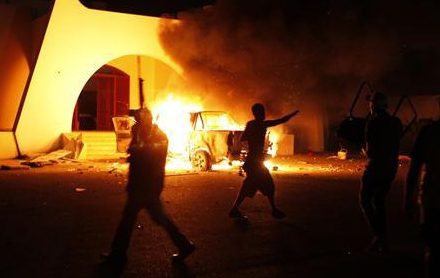
Benghazi Committee Chair Trey Gowdy: White House Witnesses Will Come Testify “Whether They Want to Or Not” (Video)

Posted by Jim Hoft on Tuesday, January 27, 2015, 10:43 AM

benghazi terrorists

Benghazi Select Committee Chairman Trey Gowdy told FOX News today that White House witnesses including National Security Advisor Susan Rice and Ben Rhodes, Deputy National Security Advisor, will come testify before the committee whether they want to or not.

“I would suspect that some, and I won’t say who, it would not be fair to Mr. Cummings, I would suspect some will come voluntarily but they’re coming whether it’s voluntarily or not. So, in urge to their benefit I would urge them to come voluntarily.”

Via America’s Newsroom: