Share

Tuesday, December 2, 2014

Oath Keepers » Blog Archive » Ben Swann Interviews Oath Keeper Sam Andrews


Oath Keepers » Blog Archive » Ben Swann Interviews Oath Keeper Sam Andrews

December 2nd, 2014

Ben Swann Interviews Oath Keeper Sam Andrews

Share on facebook Share on twitter Share on email Share on print More Sharing Services 0

Sam Andrews

Sam Andrews

Ben Swann recently interviewed the Oath Keeper team leader on the ground in Ferguson. Sam Andrews is an articulate, careful and knowledgeable man, who has been doing a fantastic job protecting those businesses in Ferguson. Our thanks go to Sam and all of his team, for a great job. You are true Oath Keepers.

https://www.youtube.com/watch?v=VoVa8J3FKBI

Implementing a Body-Worn Camera Program: Recommendations and Lessons Learned | Public Intelligence

Implementing a Body-Worn Camera Program: Recommendations and Lessons Learned | Public Intelligence


Implementing a Body-Worn Camera Program: Recommendations and Lessons Learned

The following guide was produced by by the Police Executive Research Forum under a grant from the U.S. Department of Justice Office of Community Oriented Policing Services.

Implementing a Body-Worn Camera Program: Recommendations and Lessons Learned

  • 92 pages
  • September 2014
  • 4.4 MB
Download
Over the past decade, advances in the technologies used by law enforcement agencies have been accelerating at an extremely rapid pace. Many police executives are making decisions about whether to acquire technologies that did not exist when they began their careers—technologies like automatedlicense plate readers, gunshot detection systems, facial recognition software, predictive analytics systems, communications systems that bring data to officers’laptops or handheld devices, GPS applications, and social media to investigate crimes and communicate with the public.
For many police executives, the biggest challenge is not deciding whether to adopt one particular technology but rather finding the right mix of technologies for a given jurisdiction based on its crime problems, funding levels, and other factors. Finding the best mix of technologies, however, must begin with a thorough understanding of each type of technology.
Police leaders who have deployed body-worn cameras say there are many benefits associated with the devices. They note that body-worn cameras are useful for documenting evidence; officer training; preventing and resolving complaints brought by members of the public; and strengthening police transparency, performance, and accountability. In addition, given that police now operate in a world in which anyone with a cell phone camera can record video footage of a police encounter, body-worn cameras help police departments ensure events are also captured from an officer’s perspective. Scott Greenwood of the American Civil Liberties Union (ACLU) said at the September 2013 conference:
The average interaction between an officer and a citizen in an urban area is already recorded in multiple ways. The citizen may record it on his phone. If there is some conflict happening, one or more witnesses may record it. Often there are fixed security cameras nearby that capture the interaction. So the thing that makes the most sense—if you really want accountability both for your officers and for the people they interact with—is to also have video from the officer’s perspective.
The use of body-worn cameras also raises important questions about privacy and trust. What are the privacy issues associated with recording victims of crime? How can officers maintain positive community relationships if they are ordered to record almost every type of interaction with the public? Will members of the public find it off-putting to be told by an officer, “I am recording this encounter,” particularly if the encounter is a casual one? Do body-worn cameras also undermine the trust between officers and their superiors within the police department?
In addition to these overarching issues, police leaders must also consider many practical policy issues, including the significant financial costs of deploying cameras and storing recorded data, training requirements, and rules and systems that must be adopted to ensure that body-worn camera video cannot be accessed for improper reasons.
Lessons learned about impact on community relationships
In their conversations with PERF staff members, police executives and other experts revealed a number of lessons that they have learned when addressing the impact body-worn cameras can have on community relationships:
• Engaging the community prior to implementing a camera program can help secure support for the program and increase the perceived legitimacy of the program in the community.
• Agencies have found it useful to communicate with the public, local policymakers, and other stakeholders about what the cameras will be used for and how the cameras will affect them.
• Social media is an effective way to facilitate public engagement.
• Transparency about the agency’s camera policies and practices, both prior to and after implementation, can help increase public acceptance and hold agencies accountable. Examples of transparency include posting policies on the department website and publicly releasing video recordings of controversial incidents.
• Requiring officers to record calls for service and law enforcement-related activities—rather than every encounter with the public—can ensure officers are not compelled to record the types of casual conversations that are central to building informal relationships within the community.
• In cases in which persons are unwilling to share information about a crime if they are being recorded, it is a valuable policy to give officers discretion to deactivate their cameras or to position the camera to record only audio. Officers should consider whether obtaining the information outweighs the potential evidentiary value of capturing the statement on video.
• Recording the events at a live crime scene can help officers capture spontaneous statements and impressions that may be useful in the later investigation or prosecution.
• Requiring officers to document, on camera or in writing, the reasons why they deactivated a camera in situations that they are otherwise required to record promotes officer accountability.
Addressing officer concerns
Agencies have taken various steps to address officer concerns about body-worn cameras. One of the most important steps, according to many police executives, is for agency leaders to engage in open communication with officers about what body-worn cameras will mean for them.
For example, a survey of officers conducted by the Vacaville (California) Police Department found that including officers in the implementation process—and allowing them to provide meaningful input—generated support for the cameras. Some police executives, like Chief Chitwood of Daytona Beach and Chief Lanpher of Aberdeen, have found it useful to attend officer briefings, roll calls, and meetings with union representatives to discuss the camera program. “My staff and I invested considerable time talking at briefings and department meetings with all employees who would be affected by body-worn cameras,” said Chief of Police Michael Frazier of Surprise, Arizona. “This has helped us gain support for the program.”
Many police executives said that creating implementation teams comprised of representatives from various units within the department can help improve the legitimacy of a body-worn camera program. For example, as agencies develop body-worn camera policies and protocols, it can be useful to receive input from patrol commanders and officers, investigators, training supervisors, the legal department, communications staff, Internal Affairs personnel, evidence management personnel, and others across the agency who will be involved with body-worn cameras. Police executives also said it is important to emphasize to officers that body-worn cameras are useful tools that can help them perform their duties. Chief Terry Gainer, U.S. Senate sergeant at arms, believes that framing body-worn cameras as a check on officer behavior is the wrong approach. “It’s going to be hard to encourage our officers to be the self-actualized professionals that we want them to be if we say, ‘Wear this because we’re afraid you’re bad, and cameras will help you prove that you’re good,’” said Gainer. “Body cameras should be seen as a tool for creating evidence that will help ensure public safety.”
Lieutenant John Carli of Vacaville, California, suggests that agencies frame the cameras as a teaching tool, rather than a disciplinary measure, by encouraging supervisors to review footage with officers and provide constructive feedback. One suggestion to accomplish this goal is to highlight officers whose videos demonstrate exemplary performance by showing their footage at training programs or by showing the video during an awards ceremony.

Share this:

facebooktwitterredditlinkedinmail

» New York Prepares for Riots As Grand Jury Weighs Eric Garner Decision Alex Jones' Infowars: There's a war on for your mind!


NEW YORK PREPARES FOR RIOTS AS GRAND JURY WEIGHS ERIC GARNER DECISION
Rev. Farrakhan says Islam permits attacks on whites for crimes of police


by KURT NIMMO | INFOWARS.COM | DECEMBER 2, 2014
As the video below unmistakably shows, Eric Garner was killed by the cops.


His crime? Allegedly selling cigarettes not approved and taxed by the state. Garner was knocked to the ground and a white police officer, Daniel Pantaleo, strangled him to death. The suffocation was exacerbated by the fact Garner suffered from asthma.

Unfortunately, the racial component of this murder will feed the race war hysteria coming out of Ferguson, Missouri. It will allow the race war opportunists to promote their agenda.


The race war opportunists have managed to pave over the larger issue – out of control federally militarized cops at war with citizens. All races in the United States suffer from police violence.

Following riots in Ferguson and black-on-white murder in St. Louis in reaction to a grand jury decision exonerating policeman Darren Wilson, race war activists justified the destruction of private property (including property owned by black merchants) and disrupting commerce.

The latest call for violence has come from perennial firebrand Rev. Louis Farrakhan. On Saturday, Farrakhan delivered a speech at Morgan State University, a black college in Baltimore. He said Islam permits a “law for retaliation” and violence should be used following the Michael Brown and Eric Garner grand jury decisions.

“Watch now, because once it starts, it’s on. You may not want to fight, but you better get ready. Teach your baby how to throw the bottle if they can,” he said, referring a Molotov cocktail.
He encouraged black people to disrupt commerce. “As long as they [whites] kill us [blacks] and go to Wendy’s and have a burger and go to sleep, they gonna keep killing us,” he said. “But when we die and they die, then soon we’re going to sit at a table and talk about it! We’re tired! We want some of this earth or we’ll tear this [expletive] country up!”

Police on Staten Island, where Garner was killed, are preparing for protests and possible violence in the wake of a grand jury decision.

“There certainly will be increased police presence in the area, especially around the vicinity of where they anticipate demonstrations to be taking place, and that is something that I believe the NYPD is taking very seriously,” said Assemblywoman Nicole Malliotakis. Her district includes parts of Staten Island and Brooklyn.

“Here on Staten Island, Eric Garner had a lot of friends, especially in that area, and he’s very, very well missed by a lot of people who’s anxiously waiting the decision,” said Cynthia Davis of the National Action Network. “So I even think maybe some agitators may try to worm their way in and try to cause problems, but we’re just praying and hoping that that doesn’t happen.”

New York’s Democrat Mayor, Bill de Blasio, said he does not expect violence after the grand jury decision is handed down.

“There will be protests, it’s part of a democracy. But in this city we respect that,” de Blasio said last week. “We allow protests to happen the right way and, generally speaking, in a way that really fosters non-violence and people participating in their society in the right manner.”


On Monday De Blasio met with Obama, Biden and Rev. Al Sharpton in Washington to discuss events in Ferguson.

Judge Jeanine: The tenacity of Obama's lawlessness | Fox News Video

Judge Jeanine: The tenacity of Obama's lawlessness | Fox News Video

Monday, December 1, 2014

FDA Admits the Dangers of Vaccinations | Mass Report

FDA Admits the Dangers of Vaccinations | Mass Report

http://massreport.com/fda-admits-the-dangers-of-vaccinations/


Josh PaniaguaDecember 1, 2014Conspiracy,Corruption,Government,HealthPolitics,conspiracy,Corruption,Government,HealthNews,Politics,


For years, there has been loads of speculation on the safety of vaccinations. One of the most common theories states that vaccinations cause autism in children. And now, your good friends at the FDA have approved mass manufacturing of vaccines derived from human cancer tumors.


Now, I understand that some people out there prefer to give their government the benefit of the doubt. But even these people could not deny what was said in this FDA meeting in 2012. These people openly admit that they are manufacturing a product that they are not only uncertain of, but believe it could have harmful effects (such as… cancer).


According to Dr. K:


“We have really identified three major factors that could potentially convey risk from tumor derived cells. And these include the cells themselves ….and if they were tumor-derived cells then maybe they themselves could form tumors in a vaccine recipient…”


Translation: among the three major health risks behind cancer cell vaccines is the vaccine itself. Not only that, but the FDA is very much in support of vaccine manufacturers. Just like they are very much in support of the people that put silent poisons in our food to make them turn blue.


“….we are here to consider the issues that we would like to advise the agency to consider in helping the company continue the manufacturing process, what should they be concerned about, what should they be watching for.” (Dr. D)


“Also, of course, we welcome conversations with manufacturers who are contemplating doing things which are unusual, and we will give them advice on their specific set of circumstances as well.” (Dr. P)


The people at the FDA not only lack full understanding of what the cells derived from cancer tumors can do, but they also don’t have a confident way of finding out.


“… we are trying to evaluate these rodent models to find out whether they are appropriate…..but it’s really only now that we can start to assess whether these particular recommendations are sensible. We need to determine whether they are detecting oncogenic activity of DNA, which genes they are detecting, and what the sensitivity is of these. If they are not sensitive enough to detect DNA, whether it’s amplified ….. or not, then it doesn’t make any sense to use them … I’m not optimistic that we’re going to find animal models to assess oncogenicity of DNA. That’s why I’m feeling that maybe it’s the clearance aspect that we have to deal with, with respect to DNA” (Dr. P)


“…there is a level of concern that comes with using a human tumor cell line that is not necessarily based on science, that’s based on the fact that it just seems like there could be something there that maybe we don’t understand. That’s why I think understanding everything about this that we can is really important” (Dr. W of the CDC)


Ready for the kicker? The FDA is aware of the very real possibility of vaccinations directly causing cancer.


“What I think is qualitatively different about the tumor cell lines is the fact that they can cause tumors.” (Dr. L)


“…I’m guessing the safety concerns we have are ones that you typically wouldn’t observe in humans on the time scale that a Phase I trial takes place on…We are worried about these vaccines causing cancer in people many years down the road, well beyond the conclusion of the Phase I study.” (Dr. H)


“…But certainly, if you are going to address this question about tumor risk of vaccines made in tumor cell lines, it’s going to have to be a decade’s question …” (Dr. C)


“I think the best we’re going to be able to do is tell the agency that the risk appears to be very, very low, and secondly, that you are obviously on top of this and doing the right kind of approach and the right kind of testing and, perhaps more importantly, revising it as new technology becomes available.


So I’m not sure that we can give a certainty — there’s no risk, don’t worry about this.

… It’s sort of a brave new world. We’re all doing it together. But I think you are doing a beautiful job.” (Dr. D)


They are not fully confident in safety.


“…then we get into the situation…… that we are in where the FDA does have to make decisions, and you cannot have 100 percent certainty that something is safe, but you are sure that you evaluated something to within the best limits that one can and the limits of the current technology.” (Dr. K)


The FDA fully realizes they will face from the public including doctors.


“I think there’s a brave-new-world aspect to this that we have to deal with….we have to tell providers about it in a way that they get it. I think we have to tell the public about it in a way that they get it. But I’m convinced after hearing the data today and the discussion today that these cell lines are important in continued development of vaccines.” (Dr. D)


“…. the issue of public perception. At the end of the day, information will need to be included in the vaccine safety information and the package insert.” (Dr. P)


“…The minute you describe something in the package insert in terms of potential clinical safety concerns, I think that really precludes using these cell substrates…” (Dr. G)


I think it should be noted that Dr. G, the source of that last quote, is the Director at the Office of Vaccines.


So through all of this, we’ve discovered that the FDA is aware of the dangers of vaccinations, they are aware of a very real risk that cancerous cells have on the human body, they don’t fully understand these cells, they have no current way to understand them, and they know that both doctors and people would be opposed to the idea. But despite this…


“To come back to the agency’s question of whether this Committee believes it’s correct scientifically to go forward with the development of these vaccines, our answer is yes.” (Dr. D)

Activist Post: Guess What Happened The Last Time The Price Of Oil Crashed Like This?

Sunday, November 30, 2014

Michael Snyder

Activist Post

There has only been one other time in history when the price of oil has crashed by more than 40 dollars in less than 6 months. The last time this happened was during the second half of 2008, and the beginning of that oil price crash preceded the great financial collapse that happened later that year by several months. Well, now it is happening again, but this time the stakes are even higher.

When the price of oil falls dramatically, that is a sign that economic activity is slowing down. It can also have a tremendously destabilizing effect on financial markets. As you will read about below, energy companies now account for approximately 20 percent of the junk bond market. And a junk bond implosion is usually a signal that a major stock market crash is on the way. So if you are looking for a “canary in the coal mine”, keep your eye on the performance of energy junk bonds. If they begin to collapse, that is a sign that all hell is about to break loose on Wall Street.

It would be difficult to overstate the importance of the shale oil boom to the U.S. economy. Thanks to this boom, the United States has become the largest oil producer on the entire planet.

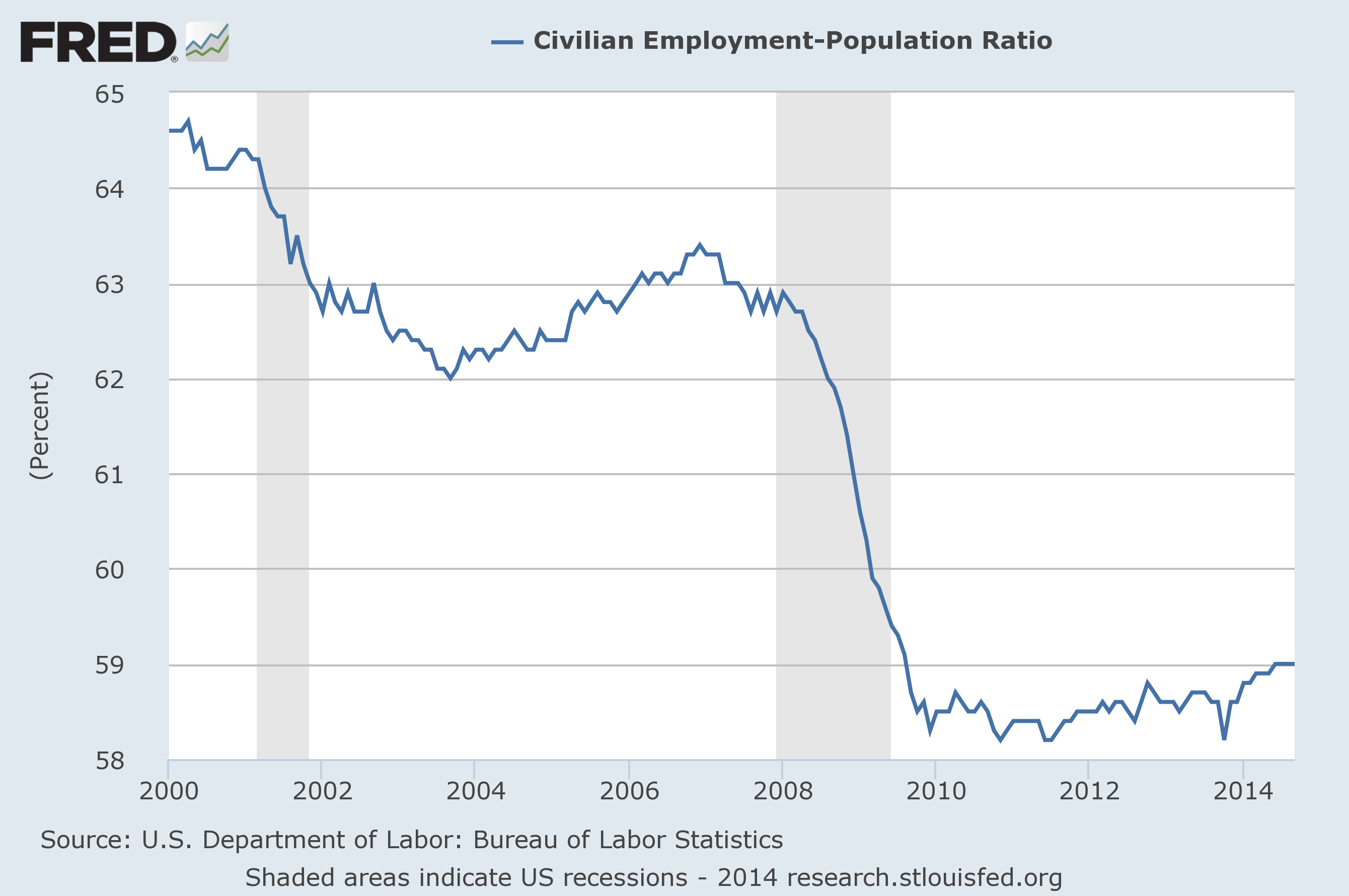
Yes, the U.S. now actually produces more oil than either Saudi Arabia or Russia. This “revolution” has resulted in the creation of millions of jobs since the last recession, and it has been one of the key factors that has kept the percentage of Americans that are employed fairly stable.

Unfortunately, the shale oil boom is coming to an abrupt end. As a recent Vox article discussed, OPEC has essentially declared a price war on U.S. shale oil producers…

For all intents and purposes, OPEC is now engaged in a “price war” with the United States. What that means is that it’s very cheap to pump oil out of places like Saudi Arabia and Kuwait. But it’s more expensive to extract oil from shale formations in places like Texas and North Dakota. So as the price of oil keeps falling, some US producers may become unprofitable and go out of business. The result? Oil prices will stabilize and OPEC maintains its market share.

If the price of oil stays at this level or continues falling, we will see a significant number of U.S. shale oil companies go out of business and large numbers of jobs will be lost. The Saudis know how to play hardball, and they are absolutely ruthless. In fact, we have seen this kind of scenario happen before

Robert McNally, a White House adviser to former President George W. Bush and president of the Rapidan Group energy consultancy, told Reuters that Saudi Arabia “will accept a price decline necessary to sweat whatever supply cuts are needed to balance the market out of the US shale oil sector.” Even legendary oil man T. Boone Pickens believes Saudi Arabia is in a stand-off with US drillers and frackers to “see how the shale boys are going to stand up to a cheaper price.” This has happened once before. By the mid-1980’s, as oil output from Alaska’s North Slope and the North Sea came on line (combined production of around 5-6 million barrels a day), OPEC set off a price war to compete for market share. As a result, the price of oil sank from around $40 to just under $10 a barrel by 1986.

But the energy sector has been one of the only bright spots for the U.S. economy in recent years. If this sector starts collapsing, it is going to have a dramatic negative impact on our economic outlook. For example, just consider the following numbers from a recent Business Insider article

Specifically, if prices get too low, then energy companies won’t be able to cover the cost of production in the US. This spending by energy companies, also known as capital expenditures, is responsible for a lot of jobs.

“The Energy sector accounts for roughly one-third of S&P 500 capex and nearly 25% of combined capex and R&D spending,” Goldman Sachs’ Amanda Sneider writes.

Even more troubling is what this could mean for the financial markets.

As I mentioned above, energy companies now account for close to 20 percent of the entire junk bond market. As those companies start to fail and those bonds start to go bad, that is going to hit our major banks really hard

Everyone could suffer if the collapse triggers a wave of defaults through the high-yield debt market, and in turn, hits stocks. The first to fall: the banks that were last hit by the housing crisis.

Why could that happen?

Well, energy companies make up anywhere from 15 to 20 percent of all U.S. junk debt, according to various sources.

It would be hard to overstate the seriousness of what the markets could potentially be facing.

One analyst summed it up to CNBC this way

“This is the one thing I’ve seen over and over again,” said Larry McDonald, head of U.S strategy at Newedge USA’s macro group. "When high yield underperforms equity, a major credit event occurs. It’s the canary in the coal mine."

The last time junk bonds collapsed, a major stock market crash followed fairly rapidly.

And those that were hardest hit were the big Wall Street banks

During the last high-yield collapse, which centered around debt tied to the housing sector, Citigroup lost 63 percent of its value in the following 60 days, Kensho shows. Bank of America was cut in half.

I understand that some of this information is too technical for a lot of people, but the bottom line is this…

Watch junk bonds. When they start crashing it is a sign that a major stock market collapse is right at the door.

At this point, even the mainstream media is warning about this. Just consider the following excerpt from a recent CNN article

That swing away from junk bonds often happens shortly before stock market downturns.

“High yield does provide useful sell signals to equity investors,” Barclays analysts concluded in a recent report.

Barclays combed through the past dozen years of data. The warning signal they found is a 30% or greater increase in the spread between Treasuries and junk bonds before a dip.

If you have been waiting for the next major financial collapse, what you have just read in this article indicates that it is now closer than it has ever been.

Over the coming weeks, keep your eye on the price of oil, keep your eye on the junk bond market and keep your eye on the big banks.

Trouble is brewing, and nobody is quite sure exactly what comes next.

This article first appeared here at the Economic Collapse Blog. Michael Snyder is a writer, speaker and activist who writes and edits his own blogs The American Dream and Economic Collapse Blog. Follow him on Twitter here.