Share

Tuesday, June 24, 2014

Secret drone kill memo released

Secret drone kill memo released

By: Zach McAuliffe Jun 23, 2014

Obama Drone Kill List

The memo used to justify the legal killing of American citizens on foreign soil by drone strikes has finally been released Monday by the Department of Justice after months of legal wrangling and pressure from the ACLU and New York Times.

The legal request for the memo came about after the 2011 deaths of three U.S. citizens in Yemen by drone strikes.

Anwar al-Awlaki and Samir Khan were killed in September 2011 while al-Awlaki’s son, Abdulrahman, was killed in October of the same year.  All three of those killed were naturalized U.S. citizens or born as such, as stated by the memo, but were also suspected of aiding al-Qaeda.

The Authorization to Use Military Force law, signed days after Sept. 11, 2001, is used largely in defense of the killing of the three without a trial.

The memo states, “the [2001 AUMF] authorizes the military detention of a U.S. citizen captured abroad who is part of an armed force within the scope of the AUMF, it also authorizes the use of ‘necessary and appropriate’ lethal force against a U.S. citizen who has joined such an armed force.”

Therefore, the government seems to believe the status of a person as an enemy combatant supersedes any previously held status by the individual as an American citizen, according to the precedents set within the memo.

Jameel Jaffer, deputy legal director of the ACLU, told the Washington Post, “The release of this memo represents an overdue but nonetheless crucial step towards transparency.”

The most outspoken members of Congress with regards to civil liberties, Democratic senators Ron Wyden of Oregon, Mark Udall of Colorado, and Martin Heinrich of New Mexico, have come out in support of the killing of the three however.

“The decision to use lethal force against Anwar al-Alwaki,” wrote the three in a letter according to MSNBC, “was a legitimate use of authority granted to the president.”

Secret drone kill memo released
Zach McAuliffe
Mon, 23 Jun 2014 22:05:40 GMT

California: 39 Women Prisoners Were Sterilized Without Consent

Many of the rights violations initially exposed by the Center for Investigate Reporting are true, according to state audit

- Max Ocean, editorial intern

The California Institution for Women in Corona, CA. (Credit: CDCR)Physicians in California prisons illegally sterilized at least 39 women during an eight-year period, with cases recorded as late as 2011, according to a report put out last week by the state's own auditing office.

Cynthia Chandler, co-founder of the Oakland-based group Justice Now, which has been raising concerns about prison sterilization processes for years, said that the report's release "feels like an incredible step and vindication for people who work toward challenging human rights abuses.”

The audit found problems in 39 cases, which account for more than a quarter of the 144 women who underwent the sterilization procedure between fiscal years 2005-6 and 2012-13. In 27 of the cases, inmates' physicians had failed to sign the necessary consent form detailing that the patients were mentally competent, had understood the lasting effects of the procedure, and that the required 30-day waiting period after initial inmate consent was given had passed. Eighteen cases potentially violated that required waiting period, which is intended to give female prisoners time to think about their decisions before their surgeries take place. In some cases there is even evidence that doctors falsified records, claiming that the waiting period had elapsed when it actually had not.

According to the report, the federal receiver’s office, which has overseen medical care in the state’s prisons since 2006, argues it has no legal obligation of ensuring prison physicians or other employees obey the consent procedures, a claim which state Sen. Ted Lieu (D-Redondo Beach) said was "ludicrous."

State Sen. Hannah-Beth Jackson (D-Santa Barbara), one of the legislators who called for the report, said its revelations show the problem to be "systemic" in nature and that there is now “clear proof that the prison environment is an environment where consent simply cannot be obtained in a responsible, reliable manner for these procedures.”

While prison medical officials have denied any intentional wrongdoing, the Center for Investigative Reporting's initial investigation into California's prison sterilization procedures last July, which prompted state legislators to demand the audit, quoted some women who said they were coerced into the procedure after their physician discovered how many children they'd given birth to, or that they'd been in prison multiple times.

The CIR report quoted one of physicians involved, Dr. James Heinrich, as saying that the $147,460 payed to doctors by the state for the surgeries was very little “compared to what you save in welfare paying for these unwanted children – as they procreated more.”

The auditor's report wasn't conclusive about the intent of the physicians involved in the cases, but it did find that the women sterilized in the eight-year period had typically been pregnant five or more times before being sterilized, tested for reading proficiency levels below high school, and had all been incarcerated at least once before.

A bill introduced by state Sen. Jackson that passed the Senate last month would ban all sterilizations of incarcerated women for birth control purposes, making them allowable only in life-threatening situations or to cure medical conditions, and would legally protect anyone trying to report such abuses.

_____________________

This work is licensed under a Creative Commons Attribution-Share Alike 3.0 License.

California: 39 Women Prisoners Were Sterilized Without Consent
Mon, 23 Jun 2014 05:00:00 GMT

Obama 'risking lives' of U.S. border agents


U.S. Border Agent wounded by rock-throwing illegal immigrants, PHOTO: Homeland Security Today

U.S. Border Agent wounded by rock-throwing illegal immigrants, PHOTO: Homeland Security Today

In the middle of the night on May 29, a U.S. Border Patrol agent identified by court records only as “S.H.” was patrolling on his bicycle near the Los Olmos Arroyo in Texas, when he spotted a group of people who appeared to have just crossed the Rio Grande from Mexico into the U.S.

According to a report in the McAllen Monitor, the agent radioed for backup before advancing toward the group, when suddenly, the illegal immigrants hiding in the darkness took off, running in all directions.

The agent gave chase through the brush, but in the darkness he was pitched from his bicycle, and his flashlight was sent flying.

As “S.H.” tried to regain his feet, court records state, 18-year-old Arnold Cruz Rivera, an illegal immigrant from Honduras, landed his first punch on the agent, then darted for a nearby stream. The agent got up and resumed the chase.

FBI agents say Rivera punched the agent in the face and chest several more times, but “S.H.” began to swing back, “not knowing where he was striking due to little to no light conditions,” until he was able to hold the fleeing suspect down until help arrived.

Today, Rivera has been formally charged with assaulting a federal officer and immigration violation, but the story is just one of many tales of peril faced by U.S. Border Patrol agents who are withstanding a marked uptick in violent assaults as they try to hold back the tide of illegal immigrants surging across the U.S. border.

In early April, for example, a Border Patrol agent in Abram, Texas, The Monitor reports, fought a Guatemalan national who rammed the agent’s head into a tree and then pushed the butt of the agent’s rifle into his face.

In early March, another Border Patrol agent in Brooks County, Texas, fought with a Salvadoran national who managed to take the agent’s handgun and fire off two shots before he was subdued.

And in November of last year, the U.S. Customs and Border Protection Agency reports, a group of 100 Mexican nationals illegally crossed into the United States and attacked U.S. Border Patrol Agents with rocks and bottles.

After the U.S. agents chased the mob back over the border, Mexican authorities allowed the suspects to disperse without being arrested or otherwise suffering any consequences for their brutal attacks on U.S. law enforcement.

“Our agents are doing the best they can with the resources they have,” Shawn Moran, vice president of the National Border Patrol Council, explained on Fox News’ “The Kelly File” earlier this month. “The Border Patrol is under siege.”

“This is something that’s been going on for over a year and is just getting worse,” he continued. “The American public needs to see what is going on. They need to see how hard our agents are working and how helpless they are to stop this and to make this situation better.”

Illegal immigration has exploded in recent months along the U.S. Mexican border, particularly in the Rio Grande Valley Sector. Border Patrol agents told Breitbart Texas that more than 1,000 illegal immigrants are apprehended each day in the RGV area.

Brandy Darby, Breitbart Texas’ managing director, has kept a chronicle of more than 40 reported assaults and drug-gang activities among the illegal aliens streaming across the border.

To make matters worse, the National Border Patrol Council, a union of U.S. Border Patrol agents, is reporting federal authorities are turning a blind eye to assaults on its members.

“The men and women of the U.S. Border Patrol are routinely attacked in remote areas along the U.S.-Mexico border, sometimes resulting in agents losing their lives for their service,” Darby wrote in November of last year. “The NBPC recently spoke out against the U.S. Border Patrol’s parent agency, Customs and Border Protection (CBP), alleging that both the CBP and the U.S. Attorney’s Office were routinely refusing to prosecute illegal immigrants who had assaulted Border Patrol agents.”

“The physical assaults on Border Patrol agents are increasing in numbers and in frequency,” added Stu Harris, vice president of Local 1929 of the NBPC. “Our Border Patrol agents are less safe now, and the dangers are increasing as they are more often working alone in isolated areas.”

Despite the increased risk, activist groups and scathing reports in mainstream media outlets have pressured the U.S. Border Patrol to put into place new restrictions on the use of force by its agents.

“Examples include refraining from blocking moving vehicles’ paths or firing at rock-throwers unless in imminent danger,” the Huffington Post reported. “Additionally, agents will be trained on how to carry and use lighter weapons, while also facing restrictions on taser use.”

Moran, however, says the additional restrictions could hinder agents’ ability to protect both the border and their own lives.

“The lives of Border Patrol agents should not be pawns in the political games of Washington, D.C.,” Moran told Breitbart Texas, “and this administration is literally risking our lives.”

“Instead of introducing … potentially restrictive policy changes, NBPC called upon CBP to open its books and provide the real story regarding the actual number of use of force incidents involving Border Patrol agents and whether force was justified,” the NBPC wrote in a released statement last year. “NBPC believes CBP should provide transparency around the criminal histories of those who allege use of force by Border Patrol agents, statistics regarding the number of assaults on Border Patrol agents, and the blatant lack of prosecutions against those who assault them.”

Zack Taylor, Chairman of the National Association of Former Border Patrol Officers, says that despite news stories painting border agents as armed aggressors against desert peasants toting only rocks, agents must have a way to defend themselves. Rocks, he pointed out, can be lethal as well.

“If you don’t throw rocks at the border patrol agent, they’re not going to shoot you,” Taylor told Breitbart Texas. “If you threaten the life of the officer, you then put the officer in a position where he has to protect his life. What do people not understand about that?”

Obama 'risking lives' of U.S. border agents
Drew Zahn
Mon, 23 Jun 2014 23:32:30 GMT

Contractor: Easy to find Lerner's 'lost' emails


lois-lerner

Ex-IRS official Lois Lerner

WASHINGTON – The CEO of a major a federal contractor, which has several contracts with the Treasury Department, says it should be relatively easy for IRS contractors to retrieve the “lost” emails of Lois Lerner, the IRS official at the center of the tea party-targeting scandal.

Ron Gula is CEO and chief technical officer of Tenable Network Security, an information technology services company nestled in the suburbs of Washington, D.C., that has major contracts with many federal agencies, including the Treasury Department’s Bureau of the Fiscal Service and United States Mint.

“It is very unlikely that the emails in question are not stored on a backup machine someplace else,” Gula told WND.

Gula also said questions about the lost emails from Chairman of the House Oversight Committee Darrell Issa, R-Calif., for Monday evening’s hearing are spot on.

Over the weekend, Issa called IRS Commissioner John Koskinen to testify Monday evening about the IRS’ “email systems, data retention policies, and document production processes.”

“Because the IRS has refused to provide basic information about these matters to the committee in advance of the hearing, and in the interest of promoting a frank and thorough discussion at the hearing, I ask that you provide answers to the factual questions posed below,” Issa said in a letter to Koskinen.

In his letter, Issa asked Koskinen to provide further details about the “failure of the hard drive,” identify employees involved in examining the hard drive, explain steps taken by the IRS to recover the information and give dates of those attempts. He also asked for the identities of all IRS employees who had any role or responsibility in maintaining or servicing IRS email servers since 2009 and for other details on the IRS archival systems.

After reviewing the letter, Gula said, “Many of the questions outlined for [Monday's] session are on the right track.” He said the emails in question could also be stored on any number of laptops and systems such as spam filters, which process email throughout the IRS.

Gula noted that because IRS contractors have the same access as employees to email systems, there shouldn’t be any issue retrieving lost data.

“In my experience, contractors who were authorized to do work for organizations like the IRS have full access to email and corporate resources,” he said.

To make email work for an organization the size of the IRS, Gula said, “there must be a great deal of redundancy and separate systems to deliver email reliably.”

WND found that several large corporations hold the IRS’ Total Information Processing Services, or TIPSS-4, contract to handle the IRS’ email servers and provide staff to work, in many cases, on site at IRS offices.

Those companies include: Accenture, Unisys, AT&T Government Solutions, Avaya Government Solutions, Booz Allen Hamilton, CGI Federal, Computer Sciences Corp., Deloitte Consulting, General Dynamics, HP Enterprises, IBM, Leidos, Lockheed Martin, Northrop Grumman Systems and Pragmatics.

Issa called an archivist from the U.S. National Archives and Records Administration and invited White House counsel Jennifer O’Connell to testify Monday in a continuation of the investigation.

Contractor: Easy to find Lerner's 'lost' emails
Alana Cook
Mon, 23 Jun 2014 23:34:46 GMT

L.A. mayor exemplifies America's decline


Last week, during the official celebration of the Los Angeles Kings winning the Stanley Cup, the mayor of Los Angeles, Eric Garcetti, told a jammed Staples Center that “there are two long-standing rules for politicians. … They say never, ever be pictured with a drink in your hand and never swear. But this is a big f––-g day,” he said, holding up a bottle of Bud Light.

You read that right. In front of 18,000 people at Staples and hundreds of thousands of others watching on television – many of them, of course, children – the mayor of the second-largest city in America held up a beer bottle and used the F-word.

This was not a whisper overheard by reporters. This was not an accidental loss of self-control. This was a planned use of obscene language in a public forum.

The question is: Does it matter?

According to the Los Angeles Times report, to the vast majority of people who heard it, it didn’t.

“The audience roared. Players stood up to applaud.

“Outside Staples Center and L.A. Live, the remarks were a hit. Lake Forest resident Jeff Ottinger, who attended Monday’s rally, said … ‘I think a lot of times politicians are uppity and stuffy and for him to actually be a fan is cool.’”

“It makes me have much more respect for him,” said Jason Werntz, 45, of Burbank.

Not only was the mayor not apologetic, he repeated his comment on Facebook and Twitter.

“Soon afterward,” the Times reported, “Garcetti had similar, PG-rated messages on Facebook and his official Twitter feed. ‘There are a few rules in politics, one is never swear, but this is a BFD. @ericgarcetti welcomes the #StanleyCup to LA.”

There are those of us who believe that this is an example of a civilization in decline (or even in free fall). And there are those who think that this is either no “BFD” (as Garcetti and his admirers might say) or actually a good thing. Here are two typical comments on the Los Angeles Times website:

Bruuuce: “I love him even more!”

MarkRomero: “I thought the comment was very humorous!! I laughed out loud when I heard it. You no sense of humor haters will never get it. That’s exactly why you are the way you are – humorless and republican, most likely. Go KINGS!”

(He is right about “Republican” – which tells you a lot about both the Republican and Democratic parties.)

Nor was support confined to anonymous commenters and thousands of fans. Not one member of the Los Angeles City Council condemned the mayor. At least one, Councilman Mike Bonin, “said he agreed with the mayor’s vivid description of the day.”

Support for the mayor must have overwhelmed objection. As reported by the Times, “A day after using the F-word in televised remarks at an L.A. Kings victory party,” Garcetti told those who found it offensive to “lighten up.”

“‘I think I was just being myself for a moment there,’ Garcetti told reporters . …

“‘Look, I think people should be kind of light about this,’ Garcetti said. ‘It’s something that plenty of people have heard in their lives for sure.’

“KNBC-TV reporter Conan Nolan asked the mayor if his cussing contributed to the coarsening of society.

“‘We micro-analyze everything,’ he added. ‘We ought to let people be people. I was just being a person yesterday.’”

So, who are those who think this reflects serious social decay?

They probably fall into two categories: those over, let’s say, 55 years of age and religious individuals of all ages.

Older Americans grew up in a religious America, and religions draw a strong distinction between the holy and the profane. That explains why even some non-religious older Americans will find this objectionable.

But the secular and left-wing tsunami of the last half century has all but extinguished the concept of the holy, and thereby extinguished the concept of the profane. If nothing is holy, nothing is profane.

Teachers tell us how common it has become for students to curse in class – including cursing teachers. Fifty years ago students were allowed to mention God in class prayer. But in 1962, Supreme Court justices considered it progressive to outlaw all school prayer. And school prayer was shortly thereafter replaced by school cursing.

To appreciate just how perverse our moral standards have become, imagine if Garcetti, instead of celebrating with a bottle of beer and the F-word, had lit up a cigar. He would have been excoriated by every liberal medium in the country. And many millions of Americans would have expressed horror at what a poor model he was for America’s children.

A society that is horrified by a mayor publicly smoking a cigar and either apathetic or enthusiastic about that mayor publicly holding up a beer bottle and cursing is in deep trouble.

One is tempted to dismiss Eric Garcetti as either a fool or a bad guy. Based on what he did, and his continuing defense of it, he may well be the former. But he is not the latter. Above all, he is a man of the left, a Democrat, and a product of a secularized culture.

Receive Dennis Prager's commentaries in your email
BONUS: By signing up for Dennis Prager's alerts, you will also be signed up for news and special offers from WND via email.
  • Name*

    FirstLast

  • Email*

    Where we will email your daily updates

  • Postal code*

    A valid zip code or postal code is required

  • Click the button below to sign up for Dennis Prager's commentaries by email, and keep up to date with special offers from WND. You may change your email preferences at any time.

L.A. mayor exemplifies America's decline
Dennis Prager
Tue, 24 Jun 2014 00:15:40 GMT

Petition begins to let soldiers see 'America'


140622america

NEW YORK – A petition on the White House website asks for 100,000 signatures by July 17 to reach the goal of petitioning the Obama administration to allow Dinesh D’Souza’s new documentary “America” to be released on U.S. military bases around the world.

The petition reads: “The feature film ‘America’ from the Oscar-winning producer Gerald R. Molen and the creator of the film ’2016: Obama’s America,’ Dinesh D’Souza, is scheduled to release through Lionsgate Films on July 2nd, 2014, on 1,000 screens across the United States.

“At this time,” it continues, “there are no plans for the film to be released on U.S. military bases around the world. Since this is a patriotic film that celebrates America, we are asking the White House to allow this film to be seen by the men and women who have sacrificed for our country, at movie theaters around the world which happen to be located on U.S. military installations.”

On June 17, a person identified only by the initials “B.N.” in Burbank, California, placed the petition on the White House website.

So far, the petition has 317 signatures.

Want to add your name to the petition? Click here!

Petitions placed on the White House website are created by people who sign up for “We the People” at WhiteHouse.gov and are not presumed to be pre-approved by the Obama administration, or necessarily in support of current Obama administration plans and policies.

New York Times blackout

In addition to being shut out from screenings on U.S. military bases around the world, D’Souza’s book “America: Imagine a World Without Her,” written as a companion to the movie, is also being shut of from the New York Times bestseller list.

Get “America: Imagine a World Without Her,” and help out WND at the same time, by clicking here!

Last week, the Washington Examiner reported D’Souza’s book “America” is not scheduled to appear on the New York Times bestseller list for the next two weeks, even though sales as reported by various book industry sales totaling organizations would place D’Souza’s book among the top 25 titles nationwide.

On Sunday, June 22, Amazon.com had D’Souza’s book “America” listed at No. 29 in the ranking of the bestselling books on Amazon.com.

D’Souza told WND last week that he expects book sales once the movie is in theaters will reach levels the New York Times will find impossible to ignore.

140622americaposterAs WND reported, D’Souza began his journey across America with a premiere screening before an overflow advance audience in New York City at the Regal Union Square Stadium 14 theater complex in Union Square.

“I want this to be an inspiring film,” D’Souza explained to the audience in a Q&A session after the screening. “I wanted to bring to life key elements of American history.”

Parked outside the theater complex on Broadway, D’Souza’s tour bus offered rock star-like advertisement for the film, with a larger-than-life portrait of D’Souza painted against the landscape and historic monuments of the nation.

“This film is my attempt to defend America when the American left is attacking the idea of the nation in moral terms, portraying America as a land where wealth has been stolen,” D’Souza said. “In this film, I counter the leftist critique of America head on.”

The screening on both screens in the Union Square movie theater complex in New York City ended with a sustained standing ovation.

In developing the storyline of his new documentary, D’Souza draws on Howard Zinn’s socialist-inspired, bestselling college textbook “A People’s History of the United States: 1482 to Present” to articulate the leftist indictment of the United States.

Documented through a series of interviews from prominent leftist authors and activists ranging from Norm Chomsky to former professor Ward Churchill, D’Souza shows how America is portrayed as a racially-oppressive nation, where power has been accumulated through imperialist foreign wars and domestic class warfare that oppresses people of color, starting with the indigenous Indian tribes displaced form their lands and slaves brought in chains from Africa.

In the second act of the film, D’Souza articulates a compelling view of American exceptionalism in which, he argues, America should not be condemned for slavery, a crime common to many nations in the age of conquest, but should be praised for being a nation willing to fight a great civil war that ended slavery.

D’Souza’s previous documentary, “2016: Obama’s America,” became the second-highest box office grossing political documentary in movie history in an election year narrative that traced the source of Barack Obama’s rage against the United States to the anti-colonial attitudes of his socialist Kenyan father.

Get “2016: Obama’s America” from the WND SuperStore now!

On May 20, WND reported D’Souza pleaded guilty in a U.S. Federal District Court in New York City of violating FEC laws in reimbursing two friends in cash for making contributions on his behalf to Wendy Long’s U.S. Senate campaign in 2012.

WND also reported Gerald Molen, the producer of both D’Souza’s feature film documentaries characterized D’Souza’s criminal indictment as a Soviet-style “political prosecution.”

“When Dinesh D’Souza can be prosecuted for making a movie, every American should ask themselves one question: ‘What will I do to preserve the First Amendment?’” Molen asked.

Petition begins to let soldiers see 'America'
Jerome R. Corsi
Tue, 24 Jun 2014 00:38:50 GMT

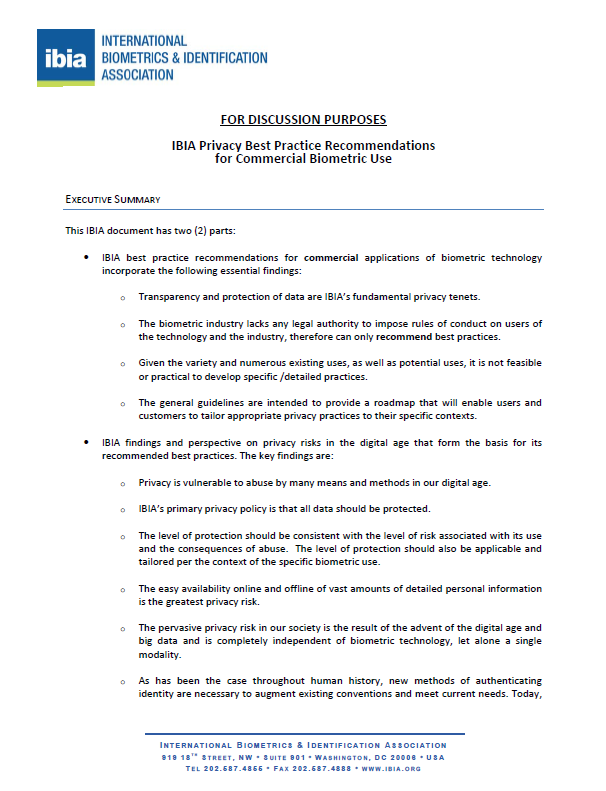
International Biometrics and Identification Association Draft Privacy Best Practices for Commercial Biometrics


The following draft best practices for privacy in the commercial use of biometrics were released by the International Biometrics and Identification Association and posted to the National Telecommunications and Information Administration website on June 17, 2014.

IBIA-PrivacyBestPractices

IBIA Privacy Best Practice Recommendations for Commercial Biometric Use
  • 9 pages
  • June 17, 2014

Download

This IBIA document has two (2) parts:

IBIA best practice recommendations for commercial applications of biometric technology incorporate the following essential findings:

o Transparency and protection of data are IBIA’s fundamental privacy tenets.
o The biometric industry lacks any legal authority to impose rules of conduct on users of the technology and the industry, therefore can only recommend best practices.
o Given the variety and numerous existing uses, as well as potential uses, it is not feasible or practical to develop specific /detailed practices.
o The general guidelines are intended to provide a roadmap that will enable users and customers to tailor appropriate privacy practices to their specific contexts.

IBIA findings and perspective on privacy risks in the digital age that form the basis for its recommended best practices. The key findings are:

o Privacy is vulnerable to abuse by many means and methods in our digital age.
o IBIA’s primary privacy policy is that all data should be protected.
o The level of protection should be consistent with the level of risk associated with its use and the consequences of abuse. The level of protection should also be applicable and tailored per the context of the specific biometric use.
o The easy availability online and offline of vast amounts of detailed personal information is the greatest privacy risk.
o The pervasive privacy risk in our society is the result of the advent of the digital age and big data and is completely independent of biometric technology, let alone a single modality.
o As has been the case throughout human history, new methods of authenticating identity are necessary to augment existing conventions and meet current needs. Today, biometric technologies do this and, as a major privacy‐enhancing technology, preserve privacy at the same time.
o The commercial application of these best practices enhances and strengthens personal privacy protections.

These findings, coupled with the Fair Information Practice Principles1 of transparency and protection of data and the reality of numerous and diverse biometric applications, provide the framework for implementing biometric technologies in commercial applications. Specifically, the IBIA’s Privacy Best Practice Recommendations for Commercial Biometric Use incorporate general guidelines for commercial use of biometrics, leaving it to implementers and operators to determine what is most appropriate given the application, the risk and consequence of abuse, the non‐biometric data used, and the purpose of the undertaking.

IBIA Findings and Perspective on Privacy Risks in the Digital Age

Following is a list of the key privacy risks that should be considered:

o Privacy in our society is vulnerable to abuse by many means and methods.
o The primary privacy risk today is the ready availability online and offline of vast amounts of detailed personal information that needs to be protected. This is completely independent of biometrics (including facial recognition).
o Privacy of our personal data has been defined and limited by the rise of the digital age that incorporates big data, completely independent of biometrics.
o Anonymity and privacy are not synonymous terms. The former is forfeited if one chooses to live in society.
o Covert surveillance methods are already widely deployed, again independent of biometrics.
o Biometric identification is filling today’s void in the need for security and privacy in uses throughout the government and commercial /consumer sectors; in law enforcement and national security; protection of health care records and financial records; to prevent imposters in professional and competency testing; in computers, mobile devices, and home door locks and safes; in school lunch programs and to protect child care facilities; and to make payments at retail establishments.
o In authentication applications like physical security access control and logical security access control for computers and networks, biometrics are privacy‐enhancing factors that provide higher security as well as privacy.
o In both one‐to‐one verification and one‐to‐many identification applications biometrics merely provides an identity result for the questions “are you who you claim to be?” or “who are you?” These results do not necessarily diminish privacy or profile a person. Instead, these applications can enhance system integrity through positive identification, can provide a higher level of user convenience and can augment privacy.

Biometrics: A Privacy Enhancing Technology

One fact should not be lost in this discussion. As has always been the case, new methods of authenticating identity, like biometric identification, are necessary to augment existing conventions and meet current needs. Biometric technologies do this and, as a major privacy‐enhancing technology, preserve privacy at the same time.

The facial template itself, like other biometric templates, provides no personal information. Indeed, protecting the non‐biometric personal information is enhanced through the use of biometric verification of identity to limit data access to only authorized persons.

Biometrics can provide a unique tool to protect and enhance both identity security and privacy and to protect against fraud and identity theft, especially as a factor in identity verification. When your personal data are protected by access mechanisms that include one or more biometric factors, it becomes much more difficult for someone else to gain access to your personal data and applications because no one else has your unique biometric attributes. This enables legitimate access and reduces the risk that a person can steal your identity and, posing as you, collect benefits; board an airplane; get a job; gain access to your personal data, etc.

Facial Recognition, Big Data, Anonymity, Surveillance, and Privacy

The perceptions that biometrics, such as facial recognition and templates generated from facial images, need to be regulated and strongly constrained because they will destroy anonymity and increase surveillance are more imagined than real, and pale in comparison to the other electronic methods that can be exploited in the digital age in which we live.

1) There is no anonymity if we choose to live in society. Anonymity and privacy are not the same. Unless we disguise ourselves, our faces are public. In society, many services are dependent on user identity. Routinely, data are used to offer goods and services to us. Anonymity cannot be used as a means to avoid accountability. Those who choose to opt in to personal offers are simply acknowledging that they want the benefits they might gain by giving up anonymity. Privacy is a different matter and surrendering a right to anonymity is not tantamount to a surrender of privacy.

Contrary to public statements, simply having access to a facial image or its template does not destroy the anonymity of a person walking down the street. This does not directly reveal a name, Social Security number, or any other personal information.

It is true that tagged photos on a social media Web site could lead you to a name or address. However, that is only one of a hundred tools that can provide the very same data. With a name alone, one can find addresses and phone numbers in public phone directories and then undertake surveillance, of a person seen on the street.

2) Surveillance is a product of the digital age, not biometrics like facial recognition. Surveillance is already a part of our daily life, thanks to the digital age and tremendous increases in computational power. Facial recognition does not increase its use.

There are two major classes of security surveillance technology in use today. One class is owned and operated by commercial businesses or individual organizations, and the other is owned or operated by local, state, or federal governments.

Commercial businesses and other non‐government organizations routinely have security cameras in and around their facilities for physical security and employee/visitor safety. Contrary to their portrayal on television programs like “24” and “Person of Interest,” among others, surveillance cameras owned by various businesses and organizations are NOT uniformly or even frequently interconnected and available to anyone with an Internet connection.

They occasionally (but rarely) run “video analytics” to automatically alert security personnel to inappropriate or unsafe activities, but almost never use automated facial recognition. If an event of interest (a crime) occurs, recordings of the event can be analyzed after the fact, and are sometimes made available to police as evidence, in accordance with the law. Images extracted from such surveillance recordings can contain faces, and these can sometimes be extracted (if the image has sufficient resolution) and converted into templates for comparison against a gallery of suspects using automated facial recognition. However, this latter process is also subject to legal rules and constraints.

There are some cities where there are a great number of centrally accessible surveillance cameras. These are of great utility in traffic management, and emergent situation assessment from a central operations center. However, resolution of the video cameras is such that they can’t practically be used for continuous facial recognition technology. The possible application of facial recognition technology is therefore generally confined to post‐event analysis, where resources can be focused on only video captured that is germane to the event being investigated, again, according to law.

Under either class of common security surveillance video technology, it isn’t practical or possible to conceive of a “face stalking” application that can be accessed and run across all the video cameras in a surveillance system. Stalking, although thankfully infrequent, occurred before the advent of facial recognition technology, and unfortunately will continue to occur, whether facial recognition becomes a factor or not. To this point, facial recognition technology has not been a factor, and likely will continue to be a non‐factor for stalking.

International Biometrics and Identification Association Draft Privacy Best Practices for Commercial Biometrics
Public Intelligence
Sat, 21 Jun 2014 23:05:42 GMT

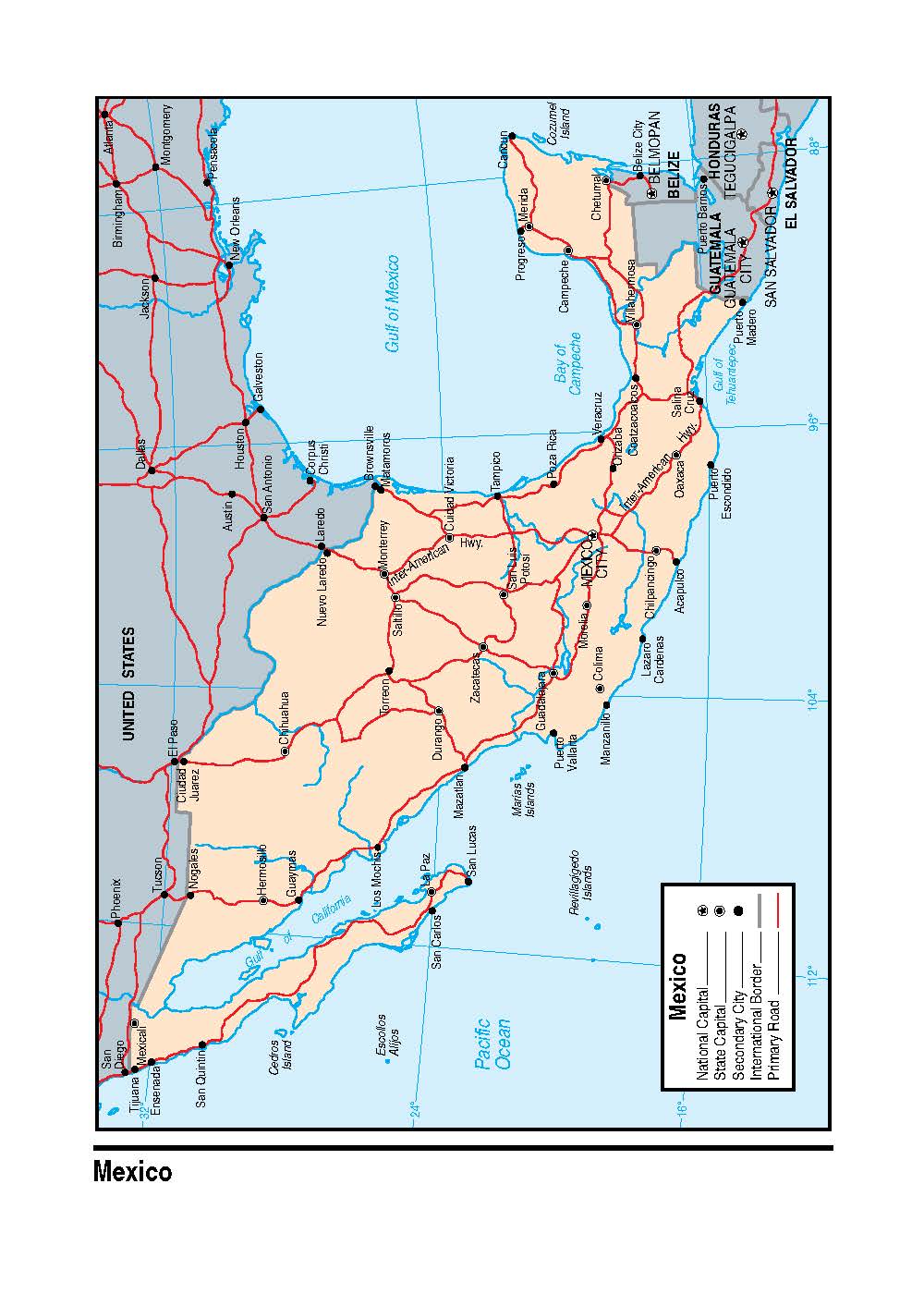
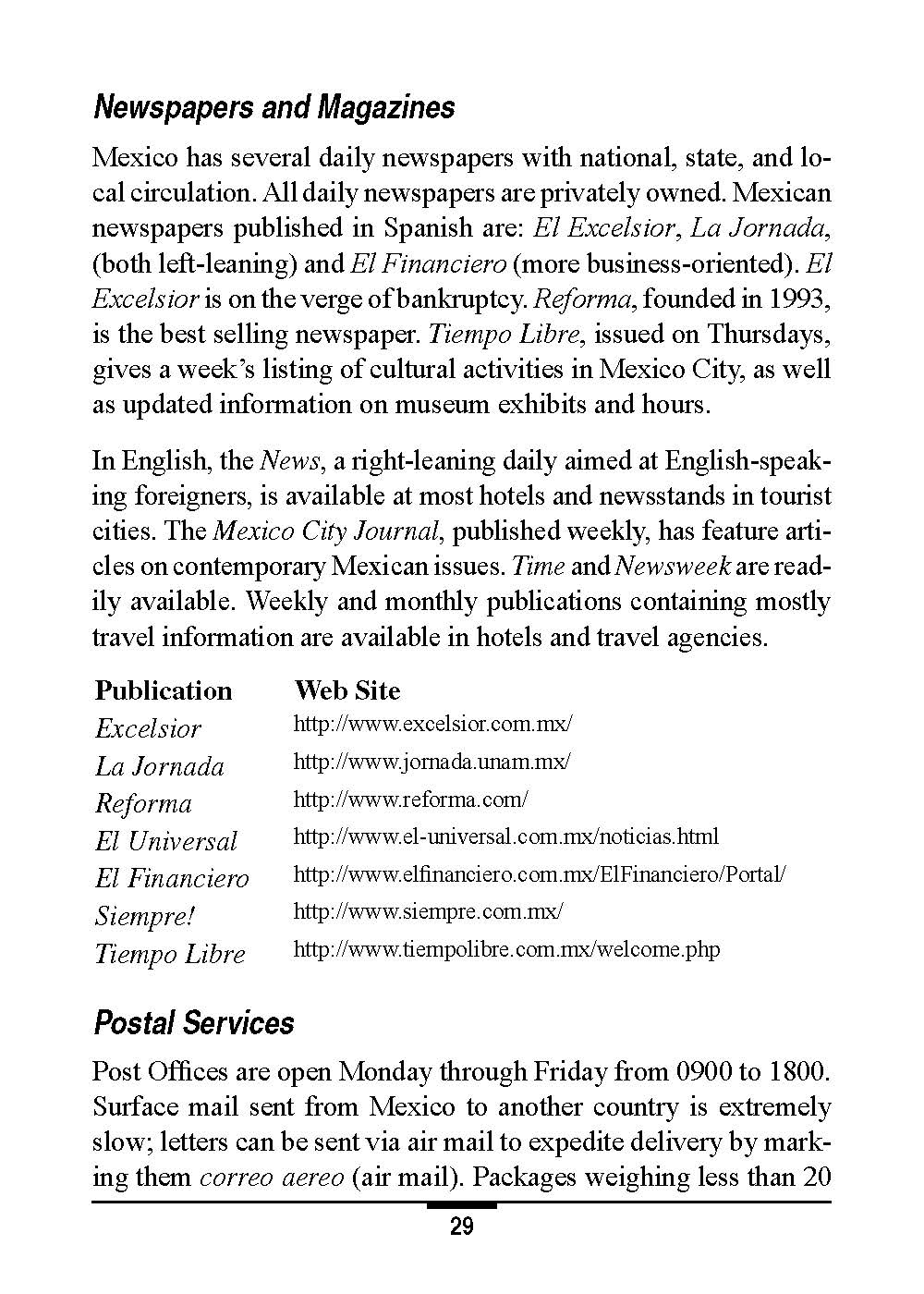
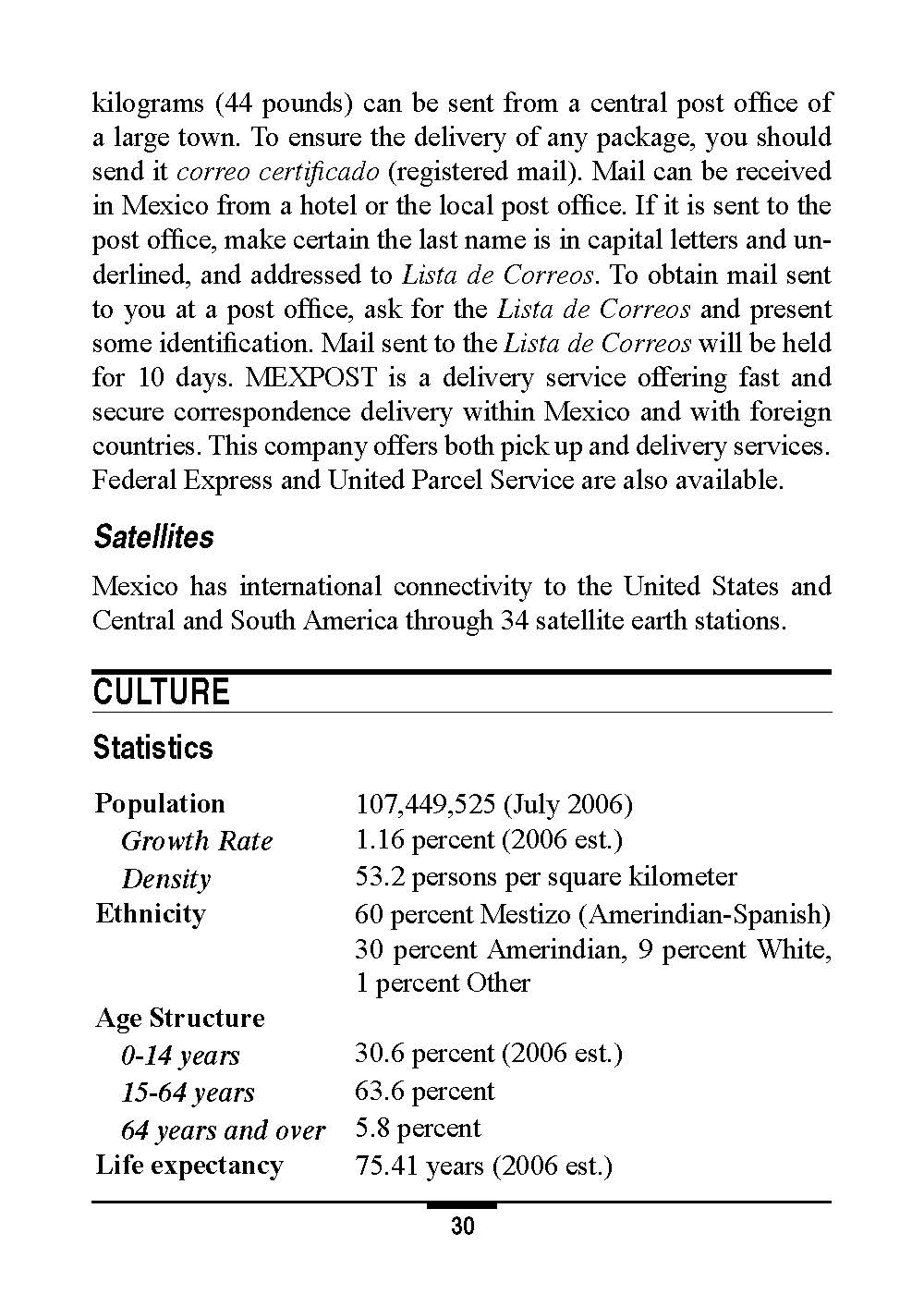
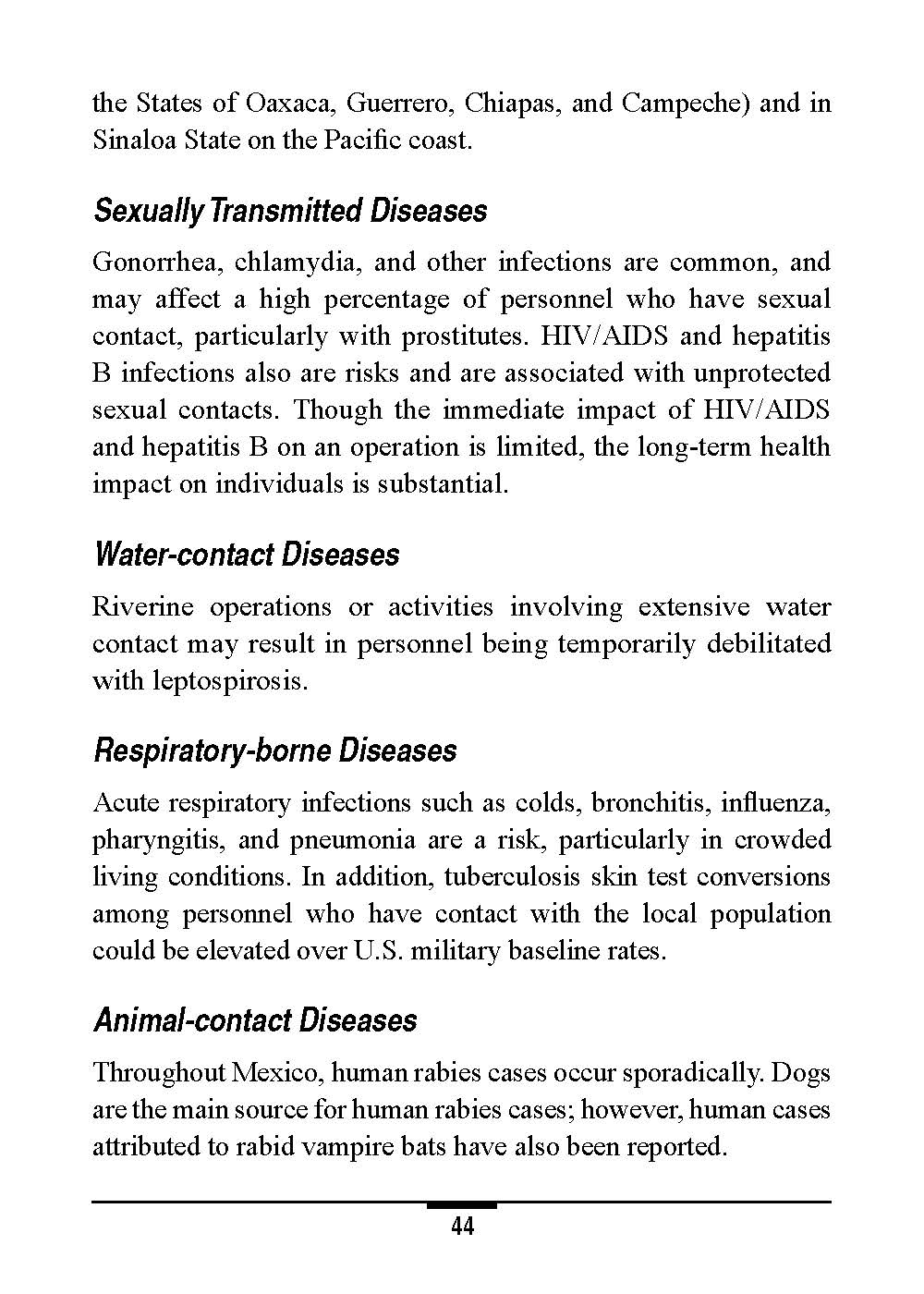
Marine Corps Intelligence Activity Mexico Country Handbook


The following guide is part of a series of handbooks covering basic information and statistics about countries around the world produced by the Marine Corps Intelligence Activity. The handbooks are not released to the public.

Mexico Country Handbook

April 2007
326 pages
Download
(PDF 5.76 MB)

This handbook provides basic reference information on Mexico, including its geography, history, government, military forces, and communications and transportation networks. This information is intended to familiarize military personnel with local customs and area knowledge to assist them during their assignment to Mexico.

The Marine Corps Intelligence Activity is the community coordinator for the Country Handbook Program. This product reflects the coordinated U.S. Defense Intelligence Community position on Mexico.

Dissemination and use of this publication is restricted to official military and government personnel from the United States of America, United Kingdom, Canada, Australia, NATO member countries, and other countries as required and designated for support of coalition operations.

The photos and text reproduced herein have been extracted solely for research, comment, and information reporting, and are intended for fair use by designated personnel in their official duties, including local reproduction for training. Further dissemination of copyrighted material contained in this document, to include excerpts and graphics, is strictly prohibited under Title 17, U.S. Code.

MCIA-MexicoHandbook_Page_010MCIA-MexicoHandbook_Page_039MCIA-MexicoHandbook_Page_040MCIA-MexicoHandbook_Page_053
MCIA-MexicoHandbook_Page_054

Marine Corps Intelligence Activity Mexico Country Handbook
Public Intelligence
Sat, 21 Jun 2014 20:14:11 GMT