

TiLTNews Network: Earth Watch - Freedom is defined by the ability of citizens to live without government interference, not by safety. It is easy to clamor for government security when terrible things happen; but liberty is given true meaning when we support it without exception, and we will be safer for it ~ Dr. Ron Paul
Friday, February 21, 2014
Court Hears Appeal from Former Guantánamo Detainees in Damages Case
A federal appeals court heard argument today on a civil lawsuit brought by six men formerly held at Guantánamo who were wrongly detained and abused while at the prison. The suit, one of the few Guantánamo damages suits still being litigated, was brought against former Defense Secretary Donald Rumsfeld and other military officials for the torture, religious abuse and other mistreatment of plaintiffs.
Court Hears Appeal from Former Guantánamo Detainees in Damages Case
jacob
Fri, 21 Feb 2014 19:59:33 GMT


The Covert Report w/ Susan Lindauer
As a U.S. Intelligence Asset, Susan Lindauer covered anti-terrorism at the Iraqi Embassy in New York from 1996 up to the invasion. Independent sources have confirmed that she gave advance warning about the 9/11 attack. She also started talks for the Lockerbie Trial with Libyan diplomats. Shortly after requesting to testify before Congress about successful elements of Pre-War Intelligence, Lindauer became one of the first non-Arab Americans arrested on the Patriot Act as an "Iraqi Agent". She was accused of warning her second cousin, White House Chief of Staff Andrew Card and Secretary of State Colin Powell that War with Iraq would have catastrophic consequences. Gratis of the Patriot Act, her indictment was loaded with "secret charges" and "secret evidence." She was subjected to one year in prison on Carswell Air Force Base in Fort Worth, Texas without a trial or hearing, and threatened with indefinite detention and forcible drugging to shut her up. After five years of indictment without a conviction or guilty plea, the Justice Department dismissed all charges five days before President Obama’s inauguration.
Lindauer has written a book Extreme Prejudice: The Terrifying Story of the Patriot Act and the Cover Ups of 9/11 and Iraq about her experience.
The Covert Report w/ Susan Lindauer
covertreport
Fri, 21 Feb 2014 22:00:00 GMT
Resistance 101: Why You Should Consider Ham Radio for Communications
Guest Post Contributed by John Q. PublicWhy communicate at all?
And you shall know the truth, and the truth shall make you free. John 8:32
For our safety, edification, and survival we need to know what is happening and what to do about it. As the plethora of prepper blogs and forums reveal, preppers have a lot to say—much of it informative, enlightening, and insightful and some of it disinformation, illogical, unmitigated drivel, and even evil. We need to screen the nuggets from the waste. Logic, critical analysis, and a well-formed conscience help us do that.
Even now, before events have hit nadir, we avoid controlled media. At best, mass media is useless; at worst, it is destructive to mind, body, and soul. What mass media provides is not news or information, but diversions, disinformation, outright lies, smut, and hasbara. Thinking people have come to depend upon the “alternative media” of the internet, but, when times get worse, the internet “kill switch” will deprive us of that source. We will be “in the dark” unless we build alternative means and networks. Better to build now than during a crisis. Amateur radio, “ham radio,” is one way to build friendships and networks now, before catastrophe peaks.
While preppers lean towards individualism, no single man, no single family can acquire all the necessary skills to thrive or even survive long term. No single man, no single family can rebuild a decent society. Very few amongst us can afford to acquire in advance all the “stuff” needed to thrive and survive. When times get worse how are the decent people to share their resources, offer their skills, communicate their needs, barter for resources that are not locally available, provide real time eyewitness news, and coordinate their good works? Want to reach a loved one when the cell system is overloaded or shut down? Use a ham radio.
Community and hence communication are essential to the good task before us. We cannot replace the diabolical command and control structure or drain the “elite’s” global cesspool unless we communicate with each other to build a decent and just society. You can be sure that our self-appointed “Masters” and their puppets and enforcers will do their worst to oppose us. We need a leg up on them.
Amateur radio is one communication tool available to us all. My intent here is only to introduce the most basic information about ham radio to the uninitiated. This brief column is not intended to provide a comprehensive compendium of technical definitions, formulae, physics, esoterica, ham slang, procedures, equipment choices, or to delineate the astonishing variety of amateur radio disciplines and niches, but only to motivate you if you are not yet a ‘ham.’
Simple foundational concepts
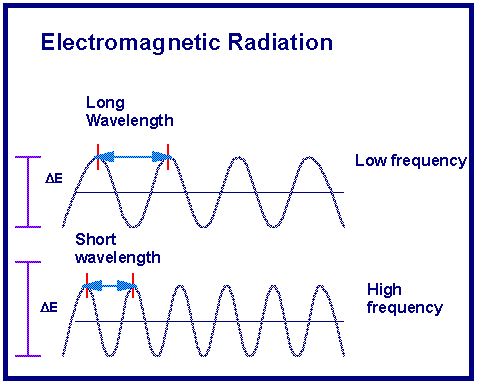
Amateur radio always involves some mention of wavelength and frequency, but these concepts are easy to visualize. For our purposes here, think of radio waves as ocean waves. The distance from wave peak to wave peak (or trough to trough) is “wavelength.” The longer the wavelength, the fewer waves touch the beach per minute (or second). The longer the wavelength, the lower the frequency; The shorter the wavelength, the higher the frequency—the first key concept.

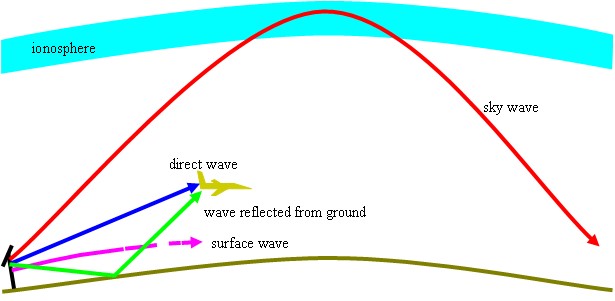
In the radio spectrum, longer wavelengths (lower frequencies) “bounce” better than shorter wavelengths (higher frequencies). These longer wavelengths can be bounced off the ground, off layers of the atmosphere, or even off the moon. The ever-changing activity of the sun (day, night, sunspots) makes an enormous difference in the electrical charges in the ionosphere and so significantly affects how well the longer wavelengths “bounce,” “propagate,” how far they “go.” Shorter wavelengths (higher frequency) do not “bounce” so well and so are limited to line-of-sight propagation. Since those longer wavelengths can bounce farther than you can see, those longer wavelengths communicate farther than line-of-sight—the second key concept.

For our purposes here, we refer to the longer “bouncy” wavelengths as high frequency (HF) and the “line-of sight” shorter wavelengths as very high frequency (VHF) and ultra high frequency (UHF). Radio wavelengths are usually expressed in meters or fractions of meters. Radio frequencies are usually expressed in “per second” or “Hertz” (abbreviated “Hz”) or “millions per second” (megahertz, MHz) or even “billions per second” (gigahertz, GHz).
So, the ham radio spectrum looks like this:
HF 3 to 30 MHz
VHF 30 MHz to 300 MHz
UHF 300 MHz to 3,000 MHz (3 GHz).All this means is that 3.750 MHz in the 80 meter HF band “bounces” better than 144.500 MHz in the 2 meter VHF band. You’ll get used to it. These concepts will quickly become second nature for you. Suffice it to say, if you want to communicate over long distances, you will want access to those “bouncy” HF bands.
Why Get Licensed?
Why? To get connected with good people of like mind. To legally operate an amateur radio now, you must be tested, licensed and you must provide an address; a private mailbox or PO Box suffices. Though such government-imposed requirements are repugnant to many, here is why you should start now—to practice important skills that will be very useful later. If you only want to talk to your buddy a few miles away, it is almost as easy to use an amateur radio as a CB radio, but to succeed in regional, transcontinental, or worldwide radio communication requires skills born of practice. If you think you can simply turn on a ham radio and send or receive real time news regionally or globally, you are sorely mistaken.
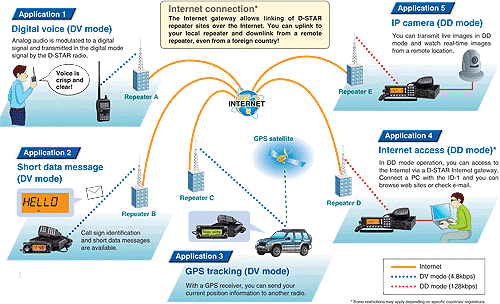
There are tools today that allow a novice to very easily use an inexpensive handheld radio to talk to other hams around the world, but this capability depends on internet digital linking. When the internet kill switch is used, there will be no more D-STAR (Digital Smart Technologies for Amateur Radio) or IRLP (Internet Radio Linking Project). When the chips are down, you will have only: (1) the short-range line-of-sight capability of VHF and UHF radio and (2) the long-range “bounce” of HF radio. While those short-range line-of-sight VHF/UHF skills are easily acquired, be sure that “DXing,” slang for making long-range contacts, requires special HF radios, more skill, more power, better antennas, and practice.
More than local news will be necessary for you to get “the big picture,” so I urge you to get your license and equipment now and start practicing. You cannot be an effective sniper with your first round and you cannot be an effective DXer with your first “QSO,” slang for “radio contact.”
Currently there are three levels of ham licenses being issued by the Federal Communications Commission (FCC): from low to high, Technician, General, and Extra. Each higher level allows more access to bandwidth, more frequencies to use. Morse code is NOT required for any class of ham license. The Technician license exam is very easy. A Technician license gives access to the relatively short-range VHF and UHF bands, but gives none of the HF access necessary for long-range communication. The General license exam is easy, only slightly more difficult than the Technician exam, and a General license allows you to legally enter the long distance world of DXing on HF. A General license is well worth the small increment of effort. The Extra licensing exam is difficult for most, but the Extra license gives access to all the frequencies legally allowed to hams.
Indeed there are many laws currently regulating ham radio usage and I urge you to learn and obey them. Practice, practice, practice… ahem… legally. Let us not review how resistance movements have used clandestine radios against the control grid.
There are two styles of study for the exams. One may simply study to pass the exam or one may study to master the information. You may choose to do both.
Gordon West has a series of books seemingly aimed at passing the exams. The first in the series is Technician Class 2010-2014.
ARRL, the American Radio Relay League, has a series of books and webpages seemingly aimed at mastering the material. The first in the series is Ham Radio License Manual Revised 2nd Edition. In far more detail than I can do here, the ARRL website provides an overview and resources for many aspects and specialty niches of ham radio, niches like “fast scan amateur TV” mentioned below. With little effort on the ARRL website’s Find A Club page, you can find a local ham club. Most clubs have training classes and members willing to be your personal ham radio mentor, in ham slang, your “Elmer.”
There are even websites dedicated to helping children obtain their licenses. For example: http://www.nc4fb.org/wordpress/kid-friendly-technician-license-self-study-program/
Some Facts, Some Gear
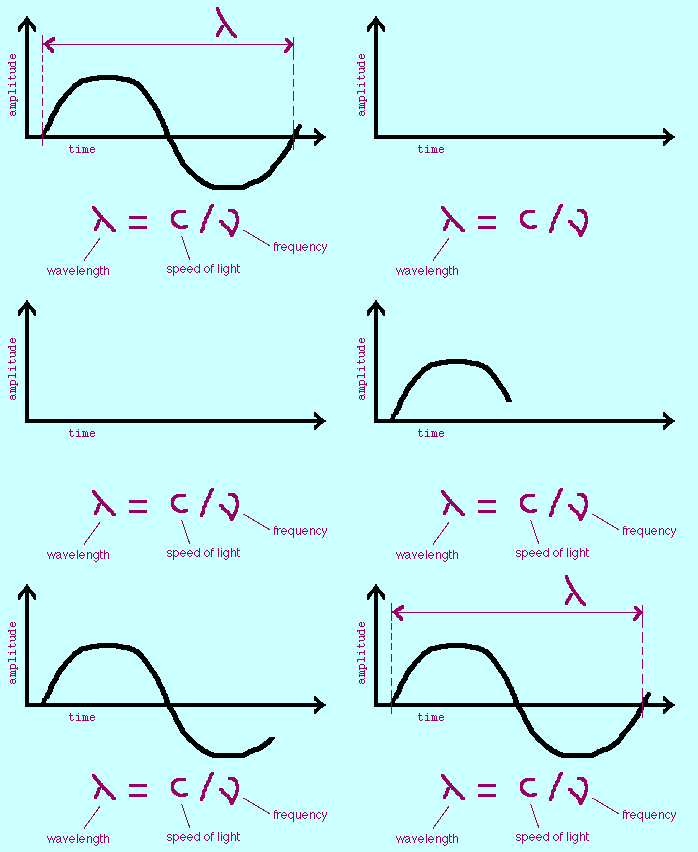
Radio “bands” are named by their wavelength or frequency, so because of the relationship between wavelength (abbreviated by the Greek lower case lambda, ?) and frequency (abbreviated by the Greek lower case nu, ?), the “40 meter band” is the same as the “7 MHz band.” As I hinted above, the reciprocal mathematical relationship of wavelength and frequency is quite simple: wavelength (?) = speed of light (c)/frequency (?).

The allocation of frequencies to bureaucratic, military, commercial, and amateur users is agreed through international treaties that are enforced by national agencies. The “band plan” for US amateurs includes access to band segments from 160 meters (1.8-2.0 MHz) to 33 centimeters (902-928 MHz), covering quite an enormous expanse of the electromagnetic spectrum. Perhaps the amateur frequency allocations are best appreciated graphically.

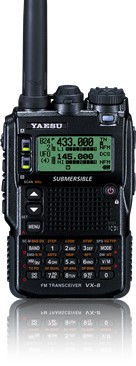
Ham “transceivers” both transmit and receive various radio bands. Radios range in price and functionality from utilitarian $100 handhelds to do-everything desktop behemoths costing thousands of dollars. Amplifiers and ancillary equipment increase range and functionality as they also add cost. You decide your budget. A small hand held transceiver, called “HT” for short, will commonly allow transmission and reception on VHF and UHF bands. Many ham HT’s also receive, but do not transmit HF, aviation bands, marine bands, and commercial AM and FM stations.
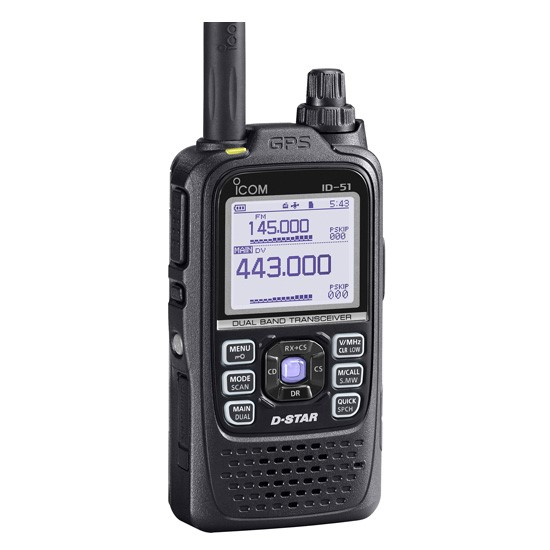
Opinions vary and tastes differ and there are certainly less expensive options, but I recommend the full feature Yaesu VX-8DR and ICOM ID-51A radios. Do not be perplexed or overwhelmed by product specifications as listed in brochures and reviews. The meaning of these specifications will become crystal clear as you study for your exam and use your own radio. Computer software and cables are available that allow you to program and clone the memories and setting of such radios more easily than tapping every memory and setting into the radio using the radios’ tiny buttons. RT Systems is among the most respected purveyors of such software. That Yaesu model has broader band access than that ICOM model, but does not have D-STAR or built-in GPS. The ICOM does have both D-STAR and built-in GPS (Global Positioning System), hence easy global access now using VHF/UHF (no HF), but, as I mentioned above, those global VHF/UHF capabilities are easily shutdown at the whim of “our” police state. Also, there may be circumstances where you might not want to automatically report your GPS location, so you might deactivate or not install such options. The ICOM ID-51A’s automatic GPS does allow automatic connection to nearby repeaters and reflectors (see below), a convenience, but you may choose instead to manually enter such information if needed. The line-of-sight range of these tiny 5 watt HT’s can be markedly improved, even to 50 miles, by connecting through suitable coaxial cable to a simple, inexpensive, and unobtrusive magnet mount antenna at home or on your vehicle. To help protect against EMP damage, our family keeps our HT radios in Faraday bags.


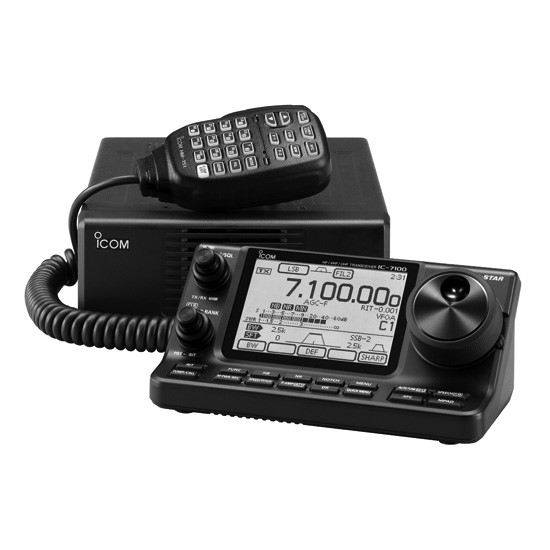
Vehicle mounted mobile transceivers markedly expand your range and bandwidth. 100-Watt mobile transceivers are common and many add HF capabilities to VHF and UHF. The very newest mobile radios, such as the touchscreen ICOM 7100, reviewed here at eham.net, include both HF and D-STAR as well as GPS capabilities if you activate it. 1,500-Watt amplifiers are optional and refined tunable antennas are available. Such units give you the best of local and worldwide digital radio now and analog radio when the internet has been killed.

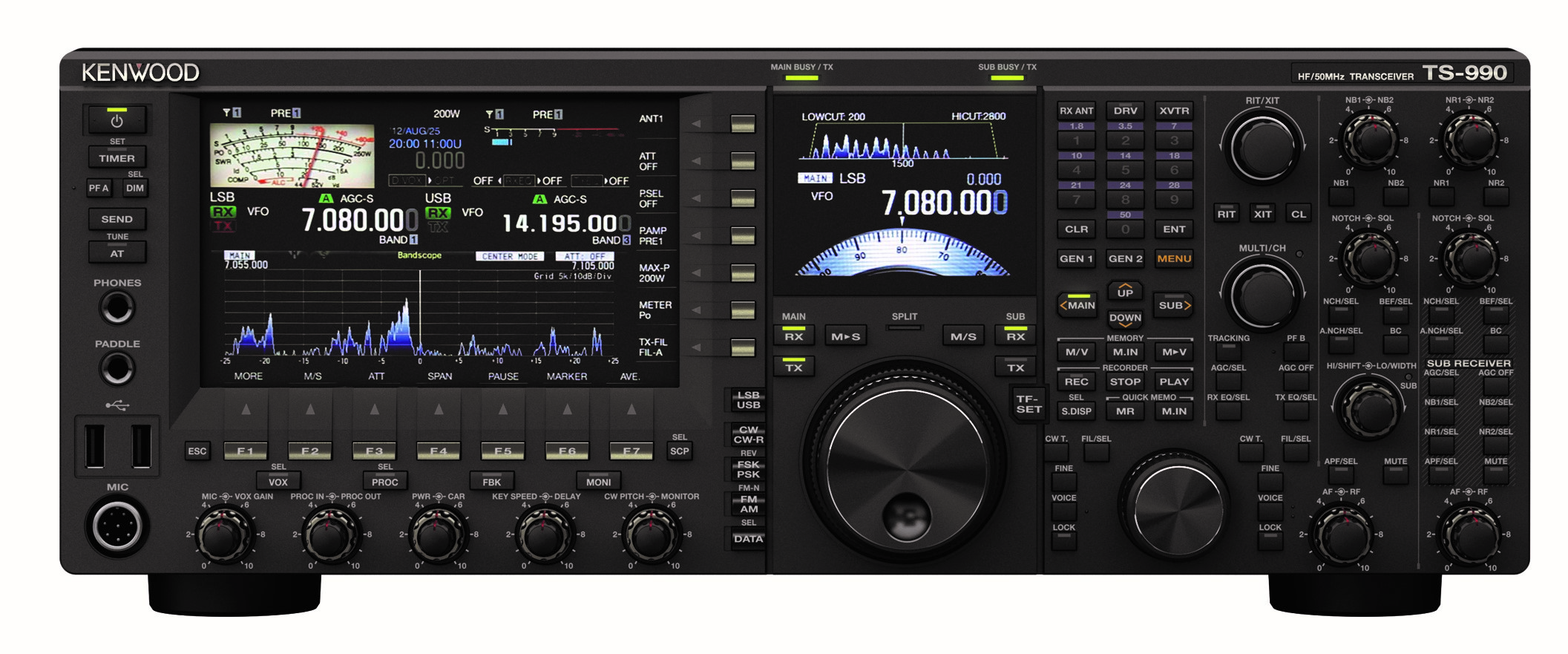
For the dedicated, practiced, and affluent ham with a “ham shack,” a 1,500-Watt desktop behemoth (for example, an amplified Kenwood TS-990S) carefully grounded and coupled to a skyful of specialized antennas is the pinnacle of amateur radio capabilities, but is far from portable. There are, of course, competing models such as the ICOM 9100, reviewed here at QST, a ham website and magazine, and here at eham.net. At about a third of the Kenwood TS-990S’s price, expect fewer features and slightly less capability. Your shopping philosophy may differ, but for firearms, optics, and tech gear, I believe, “Buy once, cry once.”

Whatever you choose, be sure to consider and purchase backup power sources for your radios—rechargeable batteries, solar chargers, generators, and even your vehicles’ batteries.
Ham Radio Outlet is one of the better-known suppliers of new and used equipment, but local and regional “hamfests” usually have swap meets. Experienced hams looking to upgrade their equipment often offer a variety of excellent used equipment at great prices though usually without warranties.
It is possible—and legal for licensed hams—to communicate through repeaters linked to a home computer without using any radio at all, even using a computer with a “dongle,” a device that allows access to D-STAR—but why? My purpose here is to motivate readers to have radio capability when the banksters’ police state murders the internet.
How It Works
Hams may communicate from radio to radio using “simplex,” taking turns to transmit and receive on the same frequency, but most VHF and UHF communication currently uses “duplex,” using two different frequencies “offset” for transmitting and receiving and often activated by subaudible “tones” through “repeaters.” Repeaters are powerful radios that, because of their prominent placement on moutaintops or tall buildings facilitate wider range communication than would be allowed by less powerful radios at ground level that are more easily blocked from line-of-sight by terrain or other obstructions. Small 5 watt HTs, may only have a useful range of 2-5 miles when communicating to another ground-level HT, but can have a useful range of 50 miles or more when using a 1,500-watt repeater on a mountaintop to relay the signal. HF and D-STAR communication always use simplex. D-STAR “reflectors” link by the internet to other reflectors around the world allowing 5 watt HTs to talk to people around the world. Reflectors and repeaters can be selectively linked for user-defined networks, but repeaters, reflectors, and linking will likely be unavailable when the internet is down.

Groups of hams with common interests meet on air for scheduled chats, called “nets.” You can form a “net” to meet others who share your particular interests. You can share computer files, photos, videos, and location information—locally or globally.

Privacy
Who has privacy? It is illegal to encrypt or encode amateur radio transmissions (business and government users may encrypt transmissions) and openly broadcasting allows anyone and everyone with a receiver to hear what you say. That is the diametric opposite of privacy—or is it? The amateur bands range from 1.8 to 3,000 MHz. That is a lot of territory available to “hide in plain sight.” Be sure too that there will be times when you want everyone to hear what you have to say.
+++
The post Resistance 101: Why You Should Consider Ham Radio for Communications appeared first on Just Wondering - Alternative News and Opinions.



Resistance 101: Why You Should Consider Ham Radio for Communications
Zen Gardner
Fri, 21 Feb 2014 20:09:40 GMT

Wednesday, February 19, 2014
U.S. and U.K. Targeted WikiLeaks With Surveillance and Political Pressure, Documents Show
The U.S. government pushed other countries to prosecute WikiLeaks founder Julian Assange, and Britain’s spy agency GCHQ collected data on everyone visiting the website, according to report today by The Intercept. The article, based on documents from Edward Snowden, also said that the NSA was considering ways to spy on the hacking group Anonymous and users of the file-sharing site Pirate Bay, even if the intercepted communications were only between Americans.
U.S. and U.K. Targeted WikiLeaks With Surveillance and Political Pressure, Documents Show
jacob
Tue, 18 Feb 2014 20:25:19 GMT
Tuesday, February 18, 2014
The United Nations Finds Another Way to Reduce the Worlds Food Supply
Image: Free Zone Media
The United Nations, not satisfied with its Agenda 21 policies and eugenics programs, has come up with another way to deprive us of food.
On the back of ‘research’ conducted by their International Seabed Authority, they have invited companies to apply for deep sea mining licenses.
The idea of exploiting the gold, copper, manganese, cobalt and other metals of the ocean floor has been considered for decades, but only recently became feasible with high commodity prices and new technology.
The study by the United Nations that the mining operations will cause “inevitable environmental damage” according to the ISA study.
There have already been 19 licenses granted, and another seven are due to be granted over the coming weeks and months.
According to the UN website:
Under the UN Convention on the Law of the Sea, the ISA was set up to encourage and manage seabed mining for the wider benefit of humanity – with a share of any profits going to developing countries.
The lure is obvious. An assessment of the eastern Pacific – a five million sq. km area known as the Clarion-Clipperton Zone – concluded that more than 27 billion tonnes of nodules could be lying on the sand.
Those rocks would contain a staggering seven billion tonnes of manganese, 340 million tonnes of nickel, 290 million tonnes of copper and 78 million tonnes of cobalt – although it’s not known how much of this is accessible.
The rape of the sea floor has been discussed for decades:
In 1970 after years of intensive efforts, the UN Assembly unanimously declared the seabed and ocean floor beyond the limits of national jurisdiction to be the common heritage of mankind and convened a conference in 1973 which would lead to establishing the International Seabed Authority to organize and control all activities in the Area with a view to administering resources. (source)
So for almost half a century, the UN has been scheming and plotting to work out how to pull this off. They have waited for the technology to become available, and now it has its all systems go.
Several things come into play here. Firstly, they may have declared the sea bed as belonging to no nation but what about the water on top of it? It will be very interesting as this expands across the oceans of the world, to find out what country A will do if country B is sending mining ships into its territorial waters without invitation.
That though, is a minor issue compared to the effect on the food chain. The Food and Agriculture Organization of the United Nations (FAO) said in 2005:
Over 852 million people on this planet don’t have enough to eat. That certainly doesn’t promote sustainable development. Millions of medium- and small-scale fishers and fish farmers, often very poor, depend on fishing and aquaculture. For FAO, fishing and aquaculture are first and foremost about people earning a living and putting food on their tables, and we do think it can be done sustainably.
Fishing and fish farming contribute to food security in three main ways. They directly increase people’s food supplies, providing highly nutritious animal protein and important micronutrients while doing so. Fish food also “fill in the gaps” during times when other food is scarce. Finally, fishing and aquaculture provide jobs and income that people use to buy other foods
Just over 100 million tonnes of fish are eaten world-wide each year, providing two and a half billion people with at least 20 percent of their average per capita animal protein intake.
This contribution is even more important in developing countries, especially small island states and in coastal regions, where frequently over 50% of people’s animal protein comes from fish. In some of the most food-insecure places — many parts of Asia and Africa, for instance — fish protein is absolutely essential, accounting for a large share of an already-low level of animal protein consumption. (emphasis added)
That was nine years ago. The population has increased in those nine years so the numbers will, if anything, be higher. Ichiro Nomura, Assistant-Director General of the FAO made these comments in an interview in Rome on June 7, 2005.
The United Nations has openly admitted that mining of the sea bed will cause damage to the environment, and that environment is the ocean. The extent of the disruption to the ecosystem is unknown, but you can bet that if the United Nations is admitting it is going to happen, then it’s going to happen big time.
As this is not something that has been done on a commercial scale before. Companies will be learning as they go along. This is hardly a sound strategy when a sizeable proportion of the global population gets more than half of their animal protein from fish.
Scientists have pleaded with the UN to stop and think before allowing companies to start their operations. The American Association for the Advancement of Science (AAAS) is calling for responsible stewardship of the ocean floor.
All the licenses issued so far are to governments and large contractors such as Lockheed Martin, and an area the size of Mexico is covered by these ‘prospecting’ licences. (source)
Feeding the world is going to be enough of a problem with the natural and/or man made weather anomalies that are sweeping the planet.
Weather experimentation looks like it will continue unabated now that the military has decided that it’s theirs to do whatever they want with. It’s becoming blatant that what they want is to be able to use the weather to manipulate agriculture, because by controlling agriculture they control the food supply, and as we are all aware, controlling the food allows you to control the people.
History proves that rebellious and starving populations can be subdued by the giving of food supplies. The threat of withholding those supplies will make the majority of the population behave for fear of starving.
Reducing the population by starvation, regardless of the cause of that starvation, is the only way they can pass the mass deaths off as ‘natural’ events.
“The weather did it”
“Global warming did it”
Those that acquiesce, who swear allegiance to the new global leaders, will be given food. The rest will die. Those who live will be the workers who live only as long as they serve those in power.
The United Nations and their partners in crime, the governments of the First World will settle for nothing less than a One World Government. A New World Order where they wear the crown, and their puppets, the presidents and prime ministers who have already bought into the plan, rule over those that are left when the genocide is over.
Genocide
noun
The deliberate killing of a large group of people, especially those of a particular nation or ethnic group.
‘a campaign of genocide’
I would say that 95% of the human population definitely constitutes a large group.
Delivered by The Daily Sheeple
Contributed by Chris Carrington of The Daily Sheeple.
Chris Carrington is a writer, researcher and lecturer with a background in science, technology and environmental studies. Chris is an editor for The Daily Sheeple. Wake the flock up!
The United Nations Finds Another Way to Reduce the Worlds Food Supply
Chris Carrington
Tue, 18 Feb 2014 22:30:38 GMT
Anti-Nuke Activists Get Years Behind Bars While 'Real Crime' Continues
Photo via Transform Now Ploughshares A 84-year-old nun and two peace activists who engaged in a non-violent demonstration at nuclear weapons production facility in Tennessee because "our very humanity rejects the designs of nuclearism, empire and war" were sentenced Tuesday to several years behind bars while critics of the verdict say the true crime of nuclear we
Anti-Nuke Activists Get Years Behind Bars While 'Real Crime' Continues
andrea
Tue, 18 Feb 2014 23:44:52 GMT
Subscribe to:
Posts
(
Atom
)